
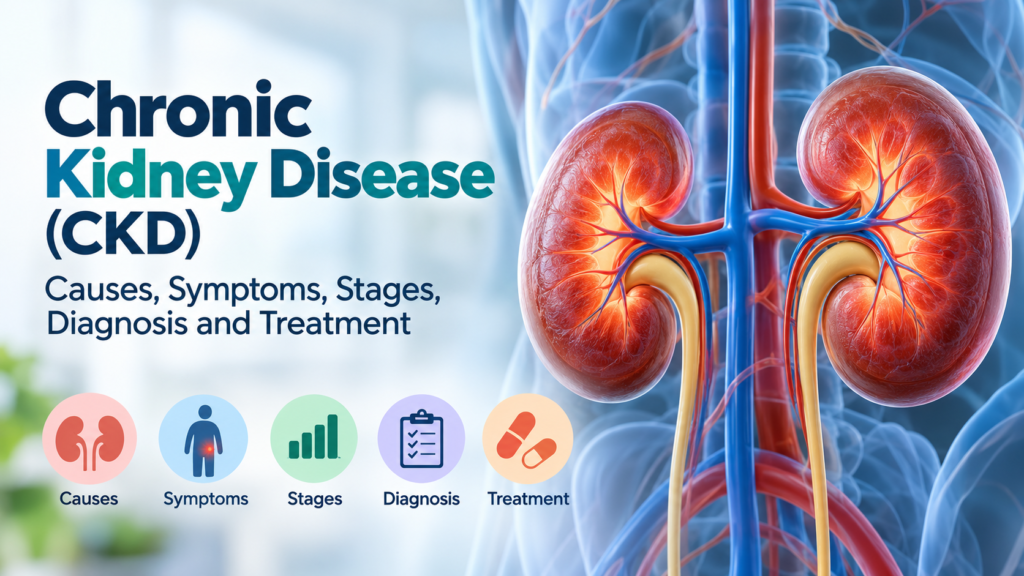
Chronic Kidney Disease (CKD): A Complete Guide to Protecting Your Kidney Health
Chronic kidney disease (CKD) is a long-term condition in which the kidneys gradually lose their ability to filter waste products, regulate fluid balance, and maintain normal levels of electrolytes and minerals in the body. CKD is a major global health problem, but early diagnosis, appropriate treatment, and healthy lifestyle changes can help slow its progression and reduce the risk of serious complications.
Many people with CKD do not experience symptoms in the early stages. Therefore, screening people at increased risk is essential, particularly those with diabetes, high blood pressure, cardiovascular disease, or a family history of kidney disease.
This article explains the causes, symptoms, stages, diagnosis, prevention, and evidence-based treatment of CKD using current international clinical guidance.
What Is Chronic Kidney Disease?
Chronic kidney disease is defined as an abnormality of kidney structure or function that persists for at least three months and has implications for health.
CKD can be diagnosed when a person has one or both of the following:
- An estimated glomerular filtration rate (eGFR) below 60 mL/min/1.73 m² for at least three months.
- Markers of kidney damage, such as persistent albumin in the urine, abnormal urine sediment, structural abnormalities on imaging, or certain kidney-related pathological findings, even when eGFR is normal.
A single abnormal creatinine result or urine test does not necessarily establish CKD. Acute kidney injury, dehydration, infection, and other temporary conditions may cause similar abnormalities. Chronicity must be established using previous results, repeat testing, and clinical assessment.
What Do the Kidneys Do?
The kidneys perform several essential functions:
- Remove waste products and excess fluid from the blood.
- Maintain electrolyte balance, including sodium and potassium.
- Regulate acid–base balance.
- Help control blood pressure.
- Produce erythropoietin, which supports red blood cell production.
- Activate vitamin D to support calcium and bone health.
When kidney function declines, waste products and fluid may accumulate, blood pressure may rise, and complications such as anemia, metabolic acidosis, and mineral and bone disorders may develop.
What Causes Chronic Kidney Disease?
The most common causes of CKD include the following.
1. Diabetes mellitus
Diabetes can damage the small blood vessels and filtering structures in the kidneys. Diabetic kidney disease may develop gradually and is often associated with albuminuria, although eGFR can decline without significant albuminuria.
Good blood glucose control, blood pressure management, and kidney-protective medications can reduce the risk of progression.
2. High blood pressure
Persistent hypertension damages the kidney’s blood vessels and filtering units. At the same time, kidney disease can worsen hypertension, creating a cycle of progressive damage.
3. Glomerular diseases
Conditions that inflame or damage the glomeruli, such as IgA nephropathy and other forms of glomerulonephritis, may cause proteinuria, blood in the urine, hypertension, and declining kidney function.
4. Inherited kidney disorders
Examples include polycystic kidney disease and other hereditary conditions that affect kidney structure or function.
5. Recurrent kidney infections or urinary obstruction
Repeated kidney infections, kidney stones, an enlarged prostate causing urinary obstruction, and other structural problems may lead to chronic kidney damage.
6. Medication-related kidney injury
Long-term or repeated exposure to certain medications can damage the kidneys, especially in people who already have CKD. Examples include nonsteroidal anti-inflammatory drugs (NSAIDs), such as ibuprofen, diclofenac, and naproxen.
Other medications may accumulate when kidney function declines and require dose adjustment even if they do not directly cause kidney damage.
7. Other causes
Additional causes include autoimmune diseases, chronic tubulointerstitial diseases, vascular disorders, and kidney damage of uncertain origin.
Identifying the underlying cause is important because some kidney diseases require specific treatment beyond general kidney-protective measures.
What Are the Symptoms of Chronic Kidney Disease?
Early CKD is often asymptomatic. A person may have reduced kidney function or significant albuminuria while feeling completely well.
As CKD progresses, symptoms may include:
- Fatigue, weakness, or reduced exercise tolerance.
- Swelling of the ankles, feet, hands, or around the eyes.
- Foamy urine, which may indicate protein in the urine.
- Blood in the urine.
- Increased or decreased urination.
- Frequent urination at night.
- Poor appetite, nausea, or vomiting.
- Muscle cramps or itching.
- Difficulty concentrating or sleep disturbances.
- Shortness of breath due to fluid overload or anemia.
These symptoms are not specific to CKD and may have other causes. Diagnosis requires appropriate laboratory testing and clinical assessment.
Seek urgent medical care for severe shortness of breath, rapidly increasing swelling, markedly reduced urine output, confusion, persistent vomiting, or chest pain.
What Are the Stages of Chronic Kidney Disease?
CKD is classified according to the cause, eGFR category, and urine albumin category. This is known as the CGA classification: Cause, GFR category, and Albuminuria category.
CKD stages according to eGFR
| Category | eGFR (mL/min/1.73 m²) | Description |
|---|---|---|
| G1 | ≥90 | Normal or high filtration; CKD requires another marker of kidney damage |
| G2 | 60–89 | Mildly decreased filtration; CKD requires another marker of kidney damage |
| G3a | 45–59 | Mildly to moderately decreased filtration |
| G3b | 30–44 | Moderately to severely decreased filtration |
| G4 | 15–29 | Severely decreased filtration |
| G5 | <15 | Kidney failure range |
G1 and G2 are not CKD by themselves if there is no evidence of kidney damage. Likewise, an eGFR below 60 must be persistent for at least three months to establish CKD unless other evidence confirms chronic disease.
Urine albumin categories
The urine albumin-to-creatinine ratio (UACR) helps determine the risk of kidney disease progression and cardiovascular complications.
| Category | UACR | Interpretation |
|---|---|---|
| A1 | <30 mg/g (<3 mg/mmol) | Normal to mildly increased |
| A2 | 30–300 mg/g (3–30 mg/mmol) | Moderately increased |
| A3 | >300 mg/g (>30 mg/mmol) | Severely increased |
Albuminuria is an important marker of kidney damage, even when eGFR is relatively preserved. A first-morning urine sample is preferred when practical, and an abnormal result should generally be confirmed.
Important: A person with G3b-A3 CKD generally has a higher risk of progression and cardiovascular events than someone with G3a-A1 CKD. Risk assessment should consider both eGFR and albuminuria, not creatinine alone.
How Is Chronic Kidney Disease Diagnosed?
The evaluation of suspected CKD usually includes the following tests.
1. Blood tests
Serum creatinine and eGFR
Creatinine is used to estimate the kidneys’ filtration capacity. eGFR is more useful than interpreting creatinine alone because the same creatinine level can represent different kidney function in different individuals.
Cystatin C, particularly when combined with creatinine, can improve the accuracy of GFR estimation when greater precision is needed or creatinine-based estimates may be misleading.
Electrolytes and metabolic tests
Depending on disease severity, tests may include potassium, sodium, bicarbonate, calcium, phosphate, and blood urea nitrogen.
Complete blood count
A CBC helps detect anemia, which becomes more common as CKD advances.
Other tests, such as glucose, HbA1c, parathyroid hormone, vitamin D, and iron studies, may be indicated according to the patient’s clinical condition.
2. Urine tests
Urine albumin-to-creatinine ratio (UACR) is the preferred initial test for detecting albuminuria.
Urinalysis may also identify blood, protein, or other abnormalities. Urine microscopy, protein quantification, or additional testing may be necessary depending on the suspected cause.
Both eGFR and urine albumin should be assessed in people at risk of CKD whenever appropriate.
3. Kidney ultrasound
Ultrasound can help identify structural abnormalities, kidney size, cysts, stones, hydronephrosis, or possible urinary obstruction.
It is particularly useful when the cause of CKD is unclear or structural disease is suspected.
4. Additional investigations
Depending on the clinical presentation, additional tests may include autoimmune markers, complement levels, hepatitis testing, monoclonal protein studies, genetic testing, or kidney biopsy.
These investigations are not necessary for every patient; they should be selected according to the suspected underlying disease.
How Is Chronic Kidney Disease Treated?
There is no single treatment that cures every form of CKD. The main goals are to treat the underlying cause, slow kidney function decline, prevent cardiovascular disease, manage complications, and prepare for kidney replacement therapy when necessary.
1. Control blood pressure
Blood pressure control is one of the most important strategies for protecting kidney function.
Angiotensin-converting enzyme inhibitors (ACE inhibitors) and angiotensin receptor blockers (ARBs) are particularly useful in patients with albuminuria. Examples include enalapril, lisinopril, losartan, and telmisartan.
The choice of medication and target blood pressure should be individualized according to albuminuria, cardiovascular risk, frailty, symptoms, and treatment tolerance.
KDIGO suggests a standardized office systolic blood pressure target below 120 mmHg for many adults with CKD when tolerated. This target should not be applied automatically to casual, non-standardized office readings or to every patient.
Safety points for ACE inhibitors and ARBs:
- Check serum creatinine and potassium before treatment and usually within 2–4 weeks after starting or increasing the dose.
- A modest initial increase in creatinine can occur.
- Investigate a creatinine increase exceeding 30% within four weeks after initiation or dose escalation.
- Monitor for hyperkalemia and symptomatic hypotension.
- ACE inhibitors and ARBs should not routinely be combined with each other.
Do not stop these medications automatically because eGFR is low. Their benefits and risks should be reviewed individually.
2. Use SGLT2 inhibitors when indicated
Sodium-glucose cotransporter-2 (SGLT2) inhibitors have become important kidney-protective therapies.
Examples include dapagliflozin and empagliflozin. Their benefits extend beyond blood glucose lowering, including reduced risk of CKD progression and selected cardiovascular outcomes.
Under the KDIGO 2024 guideline, an SGLT2 inhibitor is recommended for adults with CKD who have:
- Type 2 diabetes and an eGFR of at least 20 mL/min/1.73 m².
- An eGFR of at least 20 with UACR of at least 200 mg/g (approximately 20 mg/mmol), or heart failure, regardless of albuminuria.
- Other selected CKD presentations may qualify under the guideline’s weaker recommendation, including some adults with eGFR 20–45 and lower albuminuria.
Eligibility, local product labeling, contraindications, cost, and patient preferences should be considered.
An early, usually reversible fall in eGFR may occur after starting treatment and does not necessarily indicate kidney injury. SGLT2 inhibitors are generally withheld during prolonged fasting, major surgery, or critical illness because of ketosis risk. Patients should receive advice about volume depletion, genital infections, and symptoms of ketoacidosis.
3. Consider additional kidney-protective therapy
Finerenone
Finerenone, a nonsteroidal mineralocorticoid receptor antagonist, may be appropriate for selected patients with type 2 diabetes, persistent albuminuria, adequate eGFR, and normal potassium despite maximally tolerated renin–angiotensin system blockade.
Potassium and kidney function require monitoring because hyperkalemia can occur.
GLP-1 receptor agonists
For patients with type 2 diabetes and CKD, GLP-1 receptor agonists may help improve glycemic control, support weight management, and reduce cardiovascular risk. Some agents also have evidence of kidney benefit. Their role should be individualized according to diabetes control, cardiovascular risk, kidney function, and current diabetes guidance.
4. Control diabetes
For patients with diabetes, individualized glycemic control helps reduce the risk of kidney and other microvascular complications.
HbA1c targets should be based on age, comorbidities, risk of hypoglycemia, life expectancy, and treatment burden. HbA1c can become less reliable in advanced CKD, especially in patients with anemia or receiving erythropoiesis-stimulating agents.
5. Manage cholesterol and cardiovascular risk
CKD significantly increases cardiovascular risk.
Statin therapy, with or without ezetimibe, is recommended for many adults with non-dialysis CKD, particularly those aged 50 years or older. The choice and intensity depend on age, cardiovascular history, lipid levels, and local guidance.
Smoking cessation, physical activity, weight management, and treatment of other cardiovascular risk factors are also important.
6. Manage complications of CKD
Anemia: Evaluate iron status and other causes of anemia. Treatment may include iron replacement and, in selected cases, erythropoiesis-stimulating agents.
Metabolic acidosis: Assess serum bicarbonate and the clinical context. Treatment may be considered for clinically important acidosis, with attention to sodium load, blood pressure, and fluid status.
Hyperkalemia: Review medications, diet, acid–base status, and other reversible causes. Treatment may include dietary adjustments, diuretics, potassium binders, or other interventions according to severity.
Mineral and bone disorder: Monitor calcium, phosphate, parathyroid hormone, and vitamin D when indicated. Management should be based on trends and the severity of abnormalities rather than a single laboratory value.
Fluid overload: Sodium restriction and diuretics may help when appropriate. Fluid intake should be individualized rather than universally restricted.
7. Adjust medications to kidney function
Medication safety is essential in CKD.
- Review all prescribed medications, over-the-counter drugs, and supplements.
- Adjust doses according to kidney function and the medication’s prescribing guidance.
- Avoid unnecessary NSAID use.
- Be cautious with herbal remedies, traditional medicines, and unregulated supplements that may contain nephrotoxic ingredients or heavy metals.
- Use iodinated contrast when clinically justified, with risk assessment and preventive measures appropriate to the patient.
Patients should not discontinue prescribed medication without discussing it with their healthcare professional.
What Diet Is Recommended for Chronic Kidney Disease?
Dietary recommendations should be individualized according to CKD stage, laboratory results, nutritional status, diabetes, blood pressure, and whether the patient receives dialysis.
1. Reduce sodium
For many adults with CKD, KDIGO suggests sodium intake below 2 g per day, equivalent to less than approximately 5 g of salt per day, unless a specific clinical circumstance requires a different approach.
Limit processed foods, instant noodles, salty sauces, pickled foods, processed meats, and heavily salted snacks.
2. Consume appropriate amounts of protein
For adults with CKD stages G3–G5 who are not receiving dialysis, KDIGO suggests a protein intake of approximately 0.8 g/kg body weight per day.
Avoid high-protein diets, particularly those providing more than 1.3 g/kg/day, in people at risk of progression.
Protein restriction must not cause malnutrition. Older adults, frail patients, and those with protein-energy wasting may need a different approach. People receiving dialysis often have higher protein requirements.
3. Manage potassium according to blood results
Not every person with CKD needs a low-potassium diet.
Patients with hyperkalemia may need to reduce selected high-potassium foods, potassium additives, or potassium-containing salt substitutes. The approach should consider laboratory results, medications, constipation, and the overall dietary pattern.
4. Manage phosphorus when needed
In advanced CKD or persistent hyperphosphatemia, reduce highly absorbable phosphate additives found in some processed foods, processed meats, cola drinks, and packaged products.
Natural phosphorus in plant foods is generally less bioavailable than phosphate additives. Dietary restriction should be based on laboratory results and nutritional needs.
5. Choose a balanced dietary pattern
A kidney-friendly diet may emphasize vegetables, fruits appropriate to potassium status, whole grains, suitable protein portions, and minimally processed foods.
There is no universal food list suitable for every CKD patient. A renal dietitian can help patients meet nutritional needs without unnecessary restriction.
Exercise and Lifestyle Recommendations
Healthy lifestyle habits complement medical treatment.
- Engage in regular physical activity as tolerated, aiming for approximately 150 minutes per week of moderate-intensity activity when medically appropriate.
- Maintain a healthy weight.
- Stop smoking.
- Limit highly processed foods and excessive salt.
- Avoid excessive alcohol consumption.
- Follow recommended vaccinations and preventive care.
- Attend regular follow-up appointments and complete laboratory monitoring.
Exercise intensity should be adapted for frailty, cardiovascular disease, anemia, and other medical conditions.
How Often Should Kidney Function Be Monitored?
Monitoring frequency depends on the cause of CKD, eGFR, albuminuria, rate of progression, medications, and clinical stability.
At least annual assessment of eGFR and albuminuria is recommended for people with established CKD, with more frequent monitoring in higher-risk patients.
Monitoring should be repeated sooner after medication changes that affect kidney function or potassium, during acute illness, or when kidney function is deteriorating.
For adults with CKD G3–G5, a validated kidney failure risk equation may help estimate the risk of progression to kidney failure and guide referral and planning. Risk estimates should supplement, not replace, clinical judgment.
When Should a Patient See a Nephrologist?
Referral to a kidney specialist should be considered when there is:
- Rapid or sustained decline in eGFR.
- Advanced CKD, particularly eGFR below 30 mL/min/1.73 m².
- Severe or increasing albuminuria, especially when accompanied by hematuria.
- Persistent unexplained blood in the urine or suspected glomerular disease.
- Resistant hypertension.
- Persistent electrolyte abnormalities, metabolic acidosis, or difficult-to-manage CKD complications.
- Suspected hereditary kidney disease or uncertain cause of CKD.
- A high predicted risk of kidney failure.
Referral decisions should reflect the clinical situation and local resources.
Can Chronic Kidney Disease Be Reversed?
Some causes of kidney dysfunction are partially reversible, especially when abnormalities result from acute illness, dehydration, medication effects, or urinary obstruction.
Established chronic kidney damage, however, is often not fully reversible. The goal is to preserve remaining kidney function, treat reversible contributors, and reduce the risk of complications.
Even when eGFR is already reduced, appropriate treatment can slow further deterioration and improve quality of life.
What Happens When CKD Progresses to Kidney Failure?
Some patients eventually develop kidney failure, while others maintain stable kidney function for many years.
When kidney function becomes severely impaired, symptoms and complications may include fluid overload, hyperkalemia, acidosis, uremic symptoms, and malnutrition.
Treatment options include:
- Hemodialysis: Blood is filtered through a dialysis machine.
- Peritoneal dialysis: The lining of the abdomen is used to remove waste and excess fluid.
- Kidney transplantation: A donor kidney provides kidney function for eligible patients.
- Conservative kidney management: A patient-centered approach focused on symptom control, quality of life, and supportive care when dialysis or transplantation is not chosen or appropriate.
Planning should begin before kidney failure develops, based on the expected disease course, patient preferences, and available treatment options.
Frequently Asked Questions (FAQ)
1. What is the first sign of chronic kidney disease?
Many people have no symptoms in early CKD. Persistent albumin in the urine or a reduced eGFR on blood testing may be the first indication.
2. Can I have CKD if my creatinine is normal?
Yes. Some people have significant albuminuria or structural kidney abnormalities despite a normal serum creatinine and preserved eGFR. Both eGFR and urine albumin testing are important.
3. Can chronic kidney disease be cured?
Some underlying causes or contributing factors can be treated, but established chronic kidney damage is often permanent. Early treatment can slow progression and prevent complications.
4. Is CKD always progressive?
No. Some patients remain stable for many years. Progression depends on the underlying cause, eGFR, albuminuria, blood pressure, diabetes control, cardiovascular health, and response to treatment.
5. What foods should people with CKD avoid?
There is no single list for everyone. Many patients benefit from reducing excess salt and highly processed foods. Potassium, phosphorus, protein, and fluid restrictions should be based on kidney function, blood tests, nutritional status, and treatment.
6. How much water should a person with CKD drink daily?
There is no universal fluid target. Patients with early CKD may not need fluid restriction, while those with advanced CKD, reduced urine output, heart failure, or fluid overload may require individualized limits.
Do not force excessive water intake to “flush out” the kidneys.
7. Is coffee harmful to the kidneys?
Moderate coffee consumption is generally compatible with CKD for many people. However, caffeine may affect blood pressure or sleep, and added sugar, sodium, and potassium-containing ingredients in some drinks may be relevant.
8. Can exercise improve kidney health?
Regular physical activity can improve cardiovascular fitness, blood pressure, weight management, and overall health. Exercise does not reverse established kidney scarring, but it supports comprehensive CKD management.
9. Is dialysis necessary for everyone with stage 5 CKD?
No. Dialysis initiation depends on symptoms, complications, laboratory findings, overall health, and patient preferences, not eGFR alone. Some patients may choose transplantation, conservative kidney management, or other individualized options.
10. How often should I check my kidney function?
People with risk factors such as diabetes or hypertension should discuss screening with their healthcare professional. Once CKD is diagnosed, eGFR and urine albumin should generally be checked at least annually, and more often when disease risk or clinical circumstances warrant it.
11. Are herbal medicines safe for people with CKD?
Not necessarily. Some herbal or traditional products contain substances that can damage the kidneys, interact with prescribed medication, or contain undeclared ingredients. Discuss all supplements and traditional remedies with a healthcare professional before use.
12. Can a person with CKD live a normal life?
Many people with CKD continue to work, exercise, travel, and enjoy a good quality of life. Early diagnosis, appropriate treatment, regular monitoring, and healthy lifestyle habits can make a substantial difference.
Conclusion
Chronic kidney disease is a common and potentially serious condition that often develops silently. Diabetes, hypertension, cardiovascular disease, inherited conditions, and other kidney disorders can contribute to its development.
The most important steps are to identify CKD early, assess both eGFR and urine albumin, determine the underlying cause, control blood pressure and diabetes, use kidney-protective medications when indicated, maintain a balanced diet, and monitor for complications.
People at increased risk should discuss kidney screening with their healthcare professional. Early action can help preserve kidney function, reduce cardiovascular risk, and improve long-term health.
Medical disclaimer: This article is intended for general educational purposes and does not replace an individualized medical consultation. Diagnosis, medication selection, dietary restrictions, and treatment decisions should be made with a qualified healthcare professional.
Reviewed against international guidance: October 2026.
References and clinical guidelines
Add the following references at the end of the article. These are authoritative sources for the diagnostic criteria, CKD staging, risk assessment, and treatment recommendations.
1. Kidney Disease: Improving Global Outcomes (KDIGO) CKD Work Group. KDIGO 2024 Clinical Practice Guideline for the Evaluation and Management of Chronic Kidney Disease. Kidney International. 2024;105(4S):S117–S314. Read the full guideline on PubMed.
2. Levin A, Ahmed SB, Carrero JJ, et al. Executive summary of the KDIGO 2024 Clinical Practice Guideline for the Evaluation and Management of Chronic Kidney Disease: known knowns and known unknowns. Kidney International. 2024;105(4):684–701. Read the executive summary.
3. KDIGO. CKD Evaluation and Management: Clinical Practice Guideline Resources. Includes guideline materials and updates. Official KDIGO website.
4. Kidney Disease: Improving Global Outcomes (KDIGO). 2022 Clinical Practice Guideline for Diabetes Management in Chronic Kidney Disease. Official KDIGO guideline.
Editorial note: Before publishing, verify any new finalized KDIGO focused updates against the official guideline website. As of October 19, 2026, the CKD guideline’s focused update is in development; draft recommendations should not be presented as finalized guidance.