
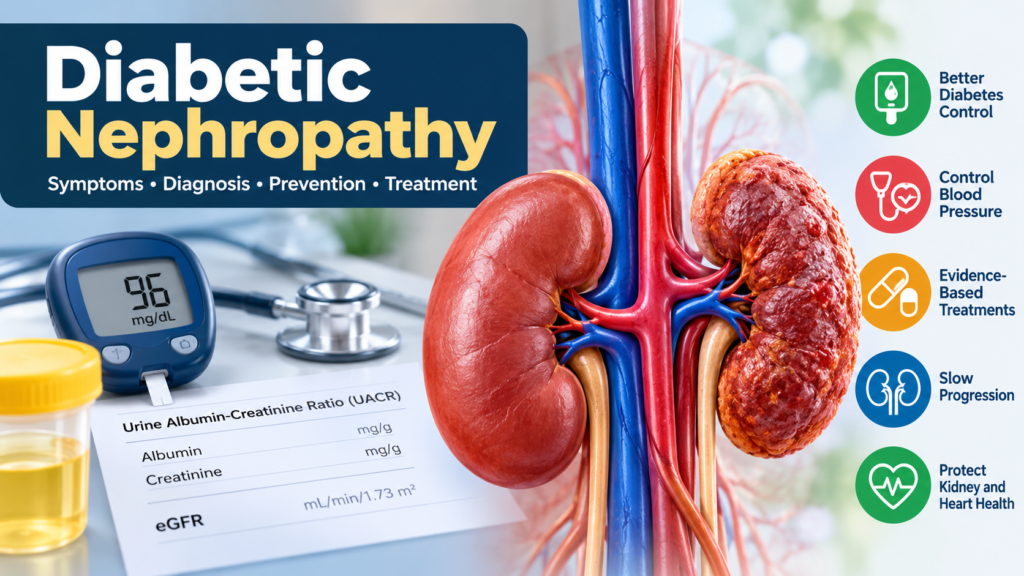
Diabetic nephropathy, more broadly referred to as diabetes-associated chronic kidney disease (CKD), is one of the most important long-term complications of diabetes mellitus. It is a major cause of chronic kidney failure and substantially increases the risk of cardiovascular disease, hospitalization, and premature mortality.
The good news is that diabetic kidney disease is preventable or its progression can be substantially slowed when it is detected early and treated appropriately.
Modern management has moved beyond simply controlling blood glucose. Current treatment focuses on a cardio-kidney-metabolic approach, combining blood pressure control, renin–angiotensin system blockade when indicated, SGLT2 inhibitors, GLP-1–based therapies, finerenone in appropriate patients, lipid management, lifestyle intervention, and regular monitoring.
The following approach is based primarily on the American Diabetes Association (ADA) Standards of Care 2026, KDIGO CKD guidance, and the 2026 ADA/EASD consensus report on type 2 diabetes.
What Is Diabetic Nephropathy?
Diabetic nephropathy is kidney damage associated with diabetes. Clinically, it is generally recognized by:
- Increased urinary albumin excretion
- Reduced estimated glomerular filtration rate (eGFR)
- Or both
The term diabetic kidney disease (DKD) is increasingly preferred because not every person with diabetes and CKD has classic pathological diabetic nephropathy.
CKD is generally diagnosed when kidney abnormalities persist for at least 3 months.
In people with diabetes, CKD is defined by persistent:
- UACR ≥30 mg/g, and/or
- eGFR <60 mL/min/1.73 m²
Other markers of kidney damage may also establish CKD.
The ADA recommends measuring both urinary albumin-to-creatinine ratio (UACR) and eGFR because each provides important prognostic information.
Why Is Diabetic Kidney Disease Important?
Diabetes can damage the kidneys through several mechanisms, including:
- Chronic hyperglycemia
- Glomerular hypertension
- Increased intraglomerular pressure
- Endothelial dysfunction
- Oxidative stress
- Inflammation
- Activation of the renin–angiotensin–aldosterone system
- Progressive glomerular and tubular injury
Initially, kidney damage may be clinically silent.
Albuminuria may develop before a substantial fall in eGFR. As the disease progresses, patients may develop:
- Progressive loss of kidney function
- Hypertension
- Edema
- Hyperkalemia
- Metabolic acidosis
- Anemia
- Mineral and bone abnormalities
- Cardiovascular disease
- Kidney failure requiring dialysis or transplantation
Importantly, CKD itself substantially increases cardiovascular risk.
Who Should Be Screened?
According to the ADA Standards of Care 2026:
Type 1 diabetes
Screening should begin after approximately 5 years of diabetes duration.
Type 2 diabetes
Screening should begin at the time of diagnosis, regardless of treatment.
Screening consists of:
- Spot urine UACR
- Serum creatinine with eGFR
The ADA recommends at least annual assessment in these populations. Once CKD is established, UACR and eGFR should generally be monitored 1–4 times per year, depending on CKD stage and risk. (Diabetes Journals)
Understanding UACR
Urinary albumin-to-creatinine ratio is one of the most important tests for diabetic kidney disease.
| UACR | Category |
|---|---|
| <30 mg/g | Normal to mildly increased |
| 30–299 mg/g | Moderately increased albuminuria |
| ≥300 mg/g | Severely increased albuminuria |
A single abnormal UACR does not necessarily establish persistent albuminuria.
Because UACR has considerable biological variability, two of three abnormal specimens collected over approximately 3–6 months are generally recommended to confirm persistent albuminuria.
UACR may temporarily increase with:
- Recent vigorous exercise
- Urinary tract infection
- Fever
- Heart failure
- Severe hyperglycemia
- Menstruation
- Marked hypertension
Therefore, abnormal results should be interpreted in clinical context. (Diabetes Journals)
Assessing eGFR
eGFR should be calculated from serum creatinine using a validated equation.
The 2021 CKD-EPI creatinine equation is recommended by the ADA.
When creatinine-based eGFR may be unreliable—for example in people with very low muscle mass, frailty, amputation, or certain liver disorders—cystatin C can provide additional information. Combining creatinine and cystatin C can improve estimation of GFR in appropriate patients. (Diabetes Journals)
CKD Risk: Think in Both eGFR and Albuminuria
Kidney risk should not be assessed using eGFR alone.
A patient with:
- eGFR 90 but UACR 500 mg/g
may have substantially greater kidney and cardiovascular risk than someone with:
- eGFR 90 and UACR <30 mg/g.
Therefore, modern diabetic kidney disease management uses the GFR category + albuminuria category to estimate risk.
When Should You Suspect Another Kidney Disease?
Not every patient with diabetes and CKD has diabetic nephropathy.
Consider another or additional kidney disease when there is:
- Rapid decline in eGFR
- Active urine sediment
- Hematuria
- Cellular casts
- Rapidly increasing proteinuria
- Nephrotic syndrome
- Very high or rapidly increasing UACR
- CKD developing unusually early
- Absence of diabetic retinopathy, particularly in type 1 diabetes
- Features suggesting systemic autoimmune, infectious, or other renal disease
In such patients, nephrology referral and sometimes kidney biopsy should be considered. (Diabetes Journals)
Major Goals of Treatment
The modern approach to diabetic kidney disease has several simultaneous goals:
- Control blood glucose
- Control blood pressure
- Reduce albuminuria
- Slow eGFR decline
- Prevent kidney failure
- Reduce cardiovascular events
- Reduce heart failure risk
- Avoid hypoglycemia
- Manage CKD complications
- Address lifestyle and cardiovascular risk factors
1. Optimize Blood Glucose
Good glycemic control remains fundamental.
For many adults with diabetes, an HbA1c target around 7% is appropriate, but targets should be individualized according to:
- Age
- Duration of diabetes
- Hypoglycemia risk
- Comorbidities
- CKD severity
- Life expectancy
- Treatment burden
- Patient preferences
Advanced CKD can increase the risk of hypoglycemia, and HbA1c may become less reliable in advanced kidney disease, particularly in the presence of anemia or altered red-cell survival. Alternative markers such as glycated albumin or fructosamine may sometimes be useful. (Diabetes Journals)
Importantly, glucose lowering alone is no longer considered sufficient kidney-protective therapy.
2. Control Blood Pressure
Blood pressure control is one of the most important interventions for slowing diabetic kidney disease.
The ADA 2026 recommends an on-treatment blood pressure goal of:
<130/80 mmHg, when it can be safely achieved.
A lower systolic target, such as <120 mmHg, may be appropriate for selected patients after considering benefits, adverse effects, frailty, orthostatic symptoms, and overall cardiovascular risk. (Diabetes Journals)
Blood pressure treatment should be individualized.
3. ACE Inhibitor or ARB When Albuminuria Is Present
For people with diabetes, hypertension, and CKD, an ACE inhibitor or ARB is particularly important when albuminuria is present.
The ADA recommends:
- ACE inhibitor or ARB for UACR 30–299 mg/g in appropriate patients
- Strong recommendation for UACR ≥300 mg/g and/or eGFR <60 mL/min/1.73 m²
- Use the maximum tolerated dose
ACE inhibitors and ARBs should not be combined because dual renin–angiotensin system blockade increases adverse events without providing additional kidney benefit. (Diabetes Journals)
Important point
ACE inhibitors and ARBs are not recommended solely to prevent CKD in a patient who has:
- Normal blood pressure
- Normal UACR
- Normal eGFR
Monitoring ACE Inhibitors and ARBs
After initiation or dose escalation, monitor:
- Serum creatinine
- eGFR
- Serum potassium
- Blood pressure
- Volume status
A moderate rise in creatinine does not automatically require discontinuation.
The ADA recommends continuing renin–angiotensin system blockade when the creatinine rise is ≤30%, provided there is no evidence of extracellular volume depletion. (Diabetes Journals)
4. SGLT2 Inhibitors: A Major Advance in Diabetic Kidney Disease
SGLT2 inhibitors have fundamentally changed the treatment of diabetic CKD.
For people with type 2 diabetes and CKD, the ADA 2026 recommends an SGLT2 inhibitor with demonstrated kidney and cardiovascular benefit.
An SGLT2 inhibitor can be initiated when:
eGFR ≥20 mL/min/1.73 m²
and, when tolerated, can generally be continued until kidney failure. (Diabetes Journals)
The kidney benefits are not simply due to lowering blood glucose.
SGLT2 inhibitors can:
- Reduce intraglomerular pressure
- Reduce albuminuria
- Slow eGFR decline
- Reduce CKD progression
- Reduce heart failure hospitalization
- Provide cardiovascular protection
The glucose-lowering effect becomes less pronounced as eGFR falls, but kidney and cardiovascular benefits persist.
Major evidence comes from trials including:
- CREDENCE
- DAPA-CKD
- EMPA-KIDNEY
SGLT2 Inhibitor Safety
Important adverse effects and precautions include:
- Genital mycotic infections
- Volume depletion
- Hypotension
- Rare diabetic ketoacidosis
- Euglycemic DKA
- Rare urinary infection complications
- Rare Fournier gangrene
Patients should receive sick-day guidance.
SGLT2 inhibitors should generally be withheld during situations such as:
- Prolonged fasting
- Severe acute illness
- Major surgery
- Significant dehydration
They should also be stopped and evaluated promptly if DKA is suspected. (Diabetes Journals)
5. GLP-1 Receptor Agonists
GLP-1 receptor agonists are increasingly important in patients with type 2 diabetes and CKD.
The ADA 2026 recommends a GLP-1 receptor agonist with demonstrated benefit to reduce cardiovascular risk and kidney disease progression in appropriate patients with type 2 diabetes and CKD. (Diabetes Journals)
Potential benefits include:
- Improved glycemic control
- Weight reduction
- Cardiovascular risk reduction
- Reduction in albuminuria
- Favorable kidney outcomes
- Low intrinsic risk of hypoglycemia when used without insulin or insulin secretagogues
Semaglutide has particularly important contemporary kidney-outcome evidence.
GLP-1–based therapy is especially useful when:
- Obesity or overweight is present
- ASCVD risk is high
- Additional glucose lowering is needed
- SGLT2 inhibitor therapy is contraindicated or insufficient
- Cardiovascular risk reduction is a major treatment objective
The 2026 ADA/EASD consensus also emphasizes earlier use of SGLT2 inhibitors and/or GLP-1-based therapies for organ protection, with combination therapy considered in people with concomitant CKD, cardiovascular disease, or heart failure. (Diabetes Journals)
6. Finerenone: Kidney and Cardiovascular Protection
Finerenone is a nonsteroidal mineralocorticoid receptor antagonist (nsMRA).
It is an important option for selected patients with:
- Type 2 diabetes
- CKD
- Albuminuria
- Adequate eGFR
- Appropriate serum potassium
The ADA 2026 recommends an nsMRA with demonstrated clinical benefit in people with diabetic CKD and albuminuria when eGFR ≥25 mL/min/1.73 m², with potassium monitoring after initiation. (Diabetes Journals)
Evidence from FIDELIO-DKD and FIGARO-DKD demonstrated reductions in important kidney and cardiovascular outcomes.
Why finerenone is different
Finerenone is not simply another blood-pressure drug.
It targets mineralocorticoid receptor–mediated inflammation and fibrosis and provides additional cardiorenal protection in appropriate patients.
Key safety issue
The major concern is:
Hyperkalemia
Therefore, serum potassium should be checked before treatment and monitored after initiation and dose adjustment.
7. Combining Kidney-Protective Therapies
Modern treatment increasingly recognizes that different therapies act through different pathways.
In appropriate patients, treatment may include:
ACE inhibitor/ARB + SGLT2 inhibitor + finerenone ± GLP-1 receptor agonist
rather than relying on one medication.
The ADA 2026 states that simultaneous initiation of an SGLT2 inhibitor and finerenone can be considered in selected adults with type 2 diabetes, UACR ≥100 mg/g and eGFR 30–90 mL/min/1.73 m² who are receiving renin–angiotensin system blockade. (Diabetes Journals)
The CONFIDENCE trial provides evidence that combined finerenone and empagliflozin produces a greater reduction in albuminuria than either treatment alone in appropriately selected patients. (Diabetes Journals)
8. Metformin in CKD
Metformin remains useful in appropriate patients with type 2 diabetes.
However:
- It is contraindicated when eGFR <30 mL/min/1.73 m²
- Treatment should be reassessed when eGFR falls below 45
- Dose and monitoring should be individualized according to kidney function and clinical circumstances
In advanced CKD, GLP-1-based therapy may be preferred for glycemic management because of its cardiovascular benefits and lower hypoglycemia risk. (Diabetes Journals)
9. Nutrition and Lifestyle
Lifestyle treatment remains essential even when modern medications are used.
Important measures include:
Healthy eating
Encourage a dietary pattern emphasizing:
- Vegetables
- Fruits in appropriate portions
- Whole grains
- Legumes
- High-quality protein
- Unsaturated fats
- Reduced refined carbohydrates
- Reduced highly processed foods
Sodium
For CKD, reducing dietary sodium to approximately:
<2,300 mg/day
may help control blood pressure and reduce cardiovascular risk, with individualization according to kidney function, medications, and comorbidities. (Diabetes Journals)
Protein
For adults with CKD stage G3 or higher who are not on dialysis, the ADA recommends approximately:
0.8 g/kg/day
Higher protein intake, particularly >1.3 g/kg/day, should generally be avoided in non-dialysis CKD. (Diabetes Journals)
Protein recommendations should be individualized, particularly in older adults, people with frailty, malnutrition, or advanced CKD.
Physical activity
Regular physical activity should be encouraged according to cardiovascular status, functional capacity, age, and comorbidities.
Smoking cessation
Smoking cessation is strongly recommended because smoking increases cardiovascular and kidney risk.
Weight management
For people with overweight or obesity, clinically meaningful weight reduction can improve:
- Glycemic control
- Blood pressure
- Cardiovascular risk
- Metabolic health
GLP-1-based therapies can be particularly useful when pharmacologic weight management is appropriate.
10. Lipid Management
People with diabetes and CKD have increased cardiovascular risk.
Statin therapy should therefore be considered according to:
- Age
- ASCVD risk
- Existing cardiovascular disease
- CKD severity
- Diabetes duration
- Other risk factors
In patients with established ASCVD or high cardiovascular risk, additional lipid-lowering therapies may be appropriate.
The treatment goal is not simply to “treat cholesterol”; it is to reduce the very high cardiovascular burden associated with diabetes and CKD.
11. Avoid Nephrotoxins
Patients with diabetic CKD should be educated about medications and exposures that can worsen kidney function.
Particular caution is required with:
- NSAIDs
- Unnecessary nephrotoxic medications
- Dehydration
- Unmonitored herbal preparations
- Certain contrast-related situations
- Inappropriate medication combinations
Medication doses should be reviewed whenever eGFR declines.
People with diabetes and CKD have an increased risk of acute kidney injury, so prevention of AKI is an important component of long-term kidney protection. (Diabetes Journals)
12. Monitor for CKD Complications
Once eGFR falls below 60 mL/min/1.73 m², clinicians should actively assess for CKD complications.
These may include:
- Anemia
- Hyperkalemia
- Metabolic acidosis
- Mineral and bone disorders
- Hyperphosphatemia
- Secondary hyperparathyroidism
- Vitamin D abnormalities
- Fluid overload
- Resistant hypertension
The frequency of laboratory monitoring should increase as CKD advances. (Diabetes Journals)
13. When Should a Patient Be Referred to a Nephrologist?
Nephrology referral should be considered for:
- eGFR <30 mL/min/1.73 m²
- Rapidly declining eGFR
- Persistent or rapidly increasing albuminuria
- Nephrotic-range proteinuria
- Active urinary sediment
- Hematuria suggesting another renal disease
- Resistant hypertension
- Persistent hyperkalemia
- Difficult electrolyte abnormalities
- Significant metabolic acidosis
- Unexplained CKD
- Suspected non-diabetic kidney disease
- Progressive CKD approaching kidney failure
Early nephrology involvement can facilitate preparation for kidney replacement therapy and management of complications. (Diabetes Journals)
Practical Clinical Algorithm
Step 1 — Screen
For people with diabetes:
UACR + eGFR
at recommended intervals.
Step 2 — Confirm
If UACR is elevated, repeat testing and confirm persistent albuminuria.
Step 3 — Stage
Classify using:
eGFR + albuminuria
Step 4 — Look for atypical features
Consider alternative kidney disease if there is:
- Hematuria
- Active sediment
- Rapid eGFR decline
- Rapidly increasing proteinuria
- Nephrotic syndrome
Step 5 — Control blood pressure
Target approximately:
<130/80 mmHg when safely achievable
Step 6 — Use ACE inhibitor/ARB when indicated
Particularly with hypertension and albuminuria.
Titrate to the maximum tolerated dose.
Step 7 — Add SGLT2 inhibitor
For appropriate patients with type 2 diabetes and CKD:
eGFR ≥20 mL/min/1.73 m²
Step 8 — Consider GLP-1-based therapy
Especially when cardiovascular risk, obesity, or additional glycemic control is important.
Step 9 — Consider finerenone
For appropriate patients with type 2 diabetes, CKD, and albuminuria, with adequate eGFR and potassium.
Step 10 — Reduce cardiovascular risk
Address:
- Lipids
- Smoking
- Weight
- Physical activity
- Diet
- ASCVD risk
Step 11 — Monitor
Follow:
- UACR
- eGFR
- Potassium
- Blood pressure
- HbA1c
- CKD complications
Can Diabetic Kidney Disease Be Reversed?
Early kidney abnormalities may improve substantially, particularly when albuminuria is identified and treated early.
However, established structural kidney damage may not be completely reversible.
The main objective is therefore:
Prevent progression and preserve kidney function for as long as possible.
A reduction in albuminuria is generally a favorable sign. The ADA recommends aiming for at least a 30% reduction in urinary albumin in people with CKD and UACR ≥300 mg/g when appropriate treatment is instituted. (Diabetes Journals)
Key Take-Home Messages
- Diabetic kidney disease is common but potentially modifiable.
- Screen type 2 diabetes with UACR and eGFR from diagnosis.
- Screen type 1 diabetes beginning approximately 5 years after diagnosis.
- Confirm persistent albuminuria rather than relying on one abnormal UACR.
- Assess kidney risk using both eGFR and albuminuria.
- Aim for individualized blood pressure control, generally <130/80 mmHg when safely achievable.
- Use an ACE inhibitor or ARB in appropriate patients with diabetes, hypertension, and albuminuria.
- Do not combine ACE inhibitors and ARBs.
- SGLT2 inhibitors are now a cornerstone of kidney protection in type 2 diabetes with CKD and can generally be initiated at eGFR ≥20.
- GLP-1-based therapy provides important cardiovascular and kidney benefits.
- Finerenone provides additional kidney and cardiovascular protection in selected patients with albuminuric diabetic CKD.
- Nutrition, exercise, weight management, smoking cessation, and avoidance of nephrotoxins remain essential.
- Refer patients with advanced, rapidly progressive, or atypical CKD to nephrology.
- Modern diabetic kidney disease treatment is increasingly multidrug, risk-based, and cardio-kidney focused, rather than simply glucose-centered.
Frequently Asked Questions
1. What is the earliest sign of diabetic nephropathy?
One of the earliest clinically detectable abnormalities is increased urinary albumin excretion, measured using the urine albumin-to-creatinine ratio (UACR).
However, albuminuria is not present in every person with diabetic CKD, so eGFR should also be assessed.
2. Can diabetic nephropathy occur with a normal eGFR?
Yes.
A patient may have:
- eGFR ≥60 mL/min/1.73 m²
but still have CKD if persistent albuminuria or another marker of kidney damage is present.
Therefore, a normal serum creatinine does not necessarily mean the kidneys are normal.
3. Can diabetic kidney disease occur without albuminuria?
Yes.
Some patients develop a progressive reduction in eGFR without significant albuminuria. This is sometimes called nonalbuminuric diabetic kidney disease.
Therefore, both UACR and eGFR are necessary for screening.
4. Does every patient with diabetes need an ACE inhibitor?
No.
ACE inhibitors or ARBs are particularly indicated when diabetes is accompanied by hypertension and albuminuria or CKD.
They are not recommended solely for primary prevention in patients with normal blood pressure, normal UACR, and normal eGFR. (Diabetes Journals)
5. Can SGLT2 inhibitors be used when eGFR is low?
Yes, in appropriate patients.
Current ADA guidance recommends initiating SGLT2 inhibitors for type 2 diabetes with CKD when eGFR is ≥20 mL/min/1.73 m².
The glucose-lowering effect becomes weaker at lower eGFR, but kidney and cardiovascular benefits remain important. (Diabetes Journals)
6. Should an SGLT2 inhibitor be stopped when eGFR falls below 20?
Not necessarily.
The ADA 2026 notes that in selected patients who tolerate therapy, an SGLT2 inhibitor may be continued even when eGFR falls below 20 until kidney failure develops, primarily for cardiovascular and kidney protection. (Diabetes Journals)
7. Can metformin be used in CKD?
Yes, within appropriate eGFR limits.
Metformin is contraindicated when eGFR is <30 mL/min/1.73 m². Treatment should be reassessed as eGFR declines, and dosing should follow current prescribing recommendations. (Diabetes Journals)
8. Is finerenone safe in diabetic kidney disease?
Finerenone can provide substantial kidney and cardiovascular benefit in appropriately selected patients.
The major concern is hyperkalemia, so potassium must be monitored carefully.
Current ADA recommendations support use of an effective nonsteroidal MRA in albuminuric diabetic CKD when eGFR is ≥25 mL/min/1.73 m². (Diabetes Journals)
9. Should patients with diabetic nephropathy eat a very low-protein diet?
Not routinely.
For CKD stage G3 or higher, the ADA recommends approximately 0.8 g/kg/day for non-dialysis patients.
Very high protein intake should generally be avoided. More restrictive diets should be individualized and supervised by an experienced renal dietitian, particularly because malnutrition can become an important concern in advanced CKD. (Diabetes Journals)
10. Can diabetic nephropathy be prevented?
Risk can be substantially reduced by:
- Good glycemic management
- Blood pressure control
- Appropriate ACE inhibitor/ARB therapy when indicated
- SGLT2 inhibitor therapy in appropriate patients
- Cardiovascular risk reduction
- Healthy diet
- Weight management
- Exercise
- Smoking cessation
- Avoidance of nephrotoxins
- Regular UACR and eGFR monitoring
Early detection is particularly important because treatment is more effective before substantial irreversible kidney damage occurs.
11. When should I see a kidney specialist?
Consult a nephrologist when kidney function is significantly reduced, particularly eGFR <30, or when there is rapid deterioration, severe albuminuria/proteinuria, hematuria, resistant hypertension, electrolyte abnormalities, or uncertainty about the cause of kidney disease. (Diabetes Journals)
Conclusion
Diabetic nephropathy is no longer managed simply by “controlling sugar.”
The modern approach is a comprehensive cardiorenal protection strategy.
Early screening with UACR and eGFR, intensive but individualized blood pressure control, appropriate use of ACE inhibitors/ARBs, SGLT2 inhibitors, GLP-1-based therapies, and finerenone, together with lifestyle intervention and cardiovascular risk reduction, can substantially slow CKD progression and reduce cardiovascular complications.
The most important principle is simple:
Detect diabetic kidney disease early, quantify both albuminuria and eGFR, and initiate kidney-protective therapy before irreversible kidney failure develops.
This article is for educational purposes and does not replace individualized medical assessment or treatment by a qualified healthcare professional.
References
- American Diabetes Association Professional Practice Committee. 11. Chronic Kidney Disease and Risk Management: Standards of Care in Diabetes—2026. Diabetes Care. 2026;49(Suppl 1):S246-S260. (Diabetes Journals)
- American Diabetes Association Professional Practice Committee. 9. Pharmacologic Approaches to Glycemic Treatment: Standards of Care in Diabetes—2026. Diabetes Care. 2026;49(Suppl 1). (Diabetes Journals)
- KDIGO. KDIGO 2024 Clinical Practice Guideline for the Evaluation and Management of Chronic Kidney Disease. Kidney International. 2024. (KDIGO)
- KDIGO. KDIGO 2022 Clinical Practice Guideline for Diabetes Management in Chronic Kidney Disease. KDIGO; current published diabetes-specific guideline, with a 2026 update in development/public review. (KDIGO)
- American Diabetes Association & European Association for the Study of Diabetes. Management of Type 2 Diabetes, 2026: A Consensus Report. Diabetes Care. 2026. (Diabetes Journals)
- Bakris GL, Agarwal R, Anker SD, et al. Effect of finerenone on chronic kidney disease outcomes in type 2 diabetes. N Engl J Med. 2020;383:2219-2229.
- Pitt B, Filippatos G, Agarwal R, et al. Cardiovascular events with finerenone in kidney disease and type 2 diabetes. N Engl J Med. 2021;385:2252-2263.
- Heerspink HJL, Stefánsson BV, Correa-Rotter R, et al. Dapagliflozin in patients with chronic kidney disease. N Engl J Med. 2020;383:1436-1446.
- Herrington WG, Staplin N, Wanner C, et al. Empagliflozin in patients with chronic kidney disease. N Engl J Med. 2023;388:117-127.
- Perkovic V, Jardine MJ, Neal B, et al. Canagliflozin and renal outcomes in type 2 diabetes and nephropathy. N Engl J Med. 2019;380:2295-2306.
- Perkovic V, Koitka-Weber A, Cooper ME, et al. Evaluation of the effects of finerenone on albuminuria in diabetic kidney disease. Kidney International.
- KDIGO. Clinical Practice Guideline for Diabetes Management in Chronic Kidney Disease. KDIGO; 2022. (KDIGO)
Guideline update note: KDIGO states that its 2022 diabetes-in-CKD guideline remains the current published KDIGO diabetes-specific guideline, while a 2026 update has been released as a draft for public review and is still undergoing revision. Therefore, this article uses the finalized ADA 2026 recommendations alongside the current published KDIGO 2022 diabetes guideline and KDIGO 2024 CKD guideline, rather than presenting the draft KDIGO 2026 update as final. (KDIGO)