
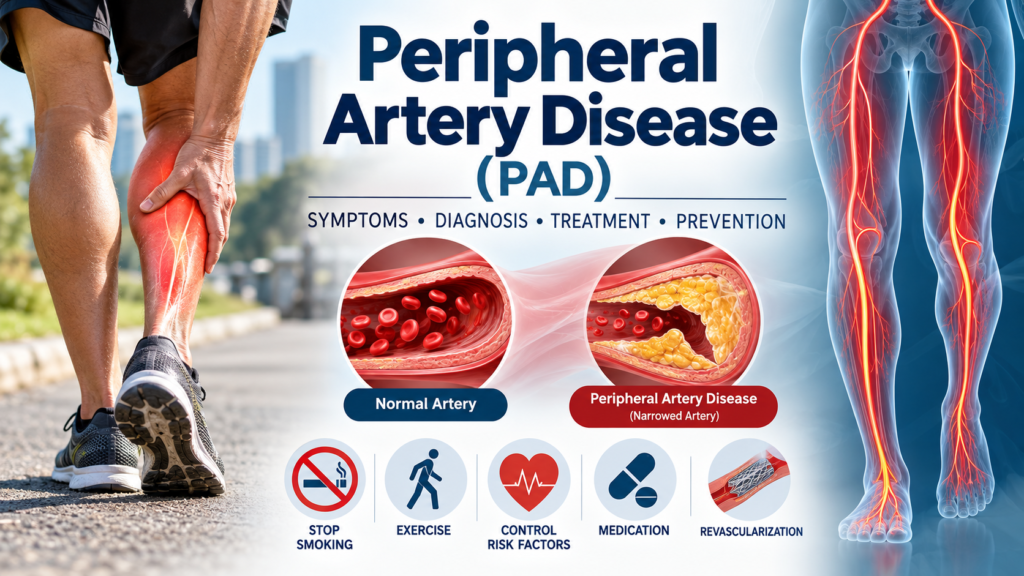
Peripheral artery disease (PAD) is a common cardiovascular condition caused most often by atherosclerotic narrowing or blockage of arteries supplying the legs. It can reduce blood flow to the lower extremities, causing leg pain during walking, impaired mobility, non-healing wounds, tissue loss, and, in severe cases, limb-threatening ischemia and amputation.
PAD is also an important marker of systemic atherosclerosis. People with PAD have a substantially increased risk of heart attack, stroke, cardiovascular death, and major adverse limb events. Early diagnosis and comprehensive cardiovascular risk reduction are therefore essential.
The 2024 ACC/AHA multisociety guideline and 2024 ESC guideline emphasize a comprehensive approach combining risk-factor modification, antithrombotic therapy, lipid lowering, blood-pressure and diabetes management, smoking cessation, structured exercise, foot care, and revascularization when appropriate.
What Is Peripheral Artery Disease?
Peripheral artery disease is a condition in which arteries outside the heart and brain become narrowed or blocked. In clinical practice, lower-extremity PAD is most commonly caused by atherosclerosis, in which cholesterol-containing plaques accumulate within the arterial wall.
The disease may affect the:
- Aortoiliac arteries
- Femoral arteries
- Popliteal arteries
- Tibial and peroneal arteries
- Other arteries supplying the lower extremities
PAD can be present without symptoms, but patients may develop exertional leg symptoms, chronic limb-threatening ischemia, or acute limb ischemia. The 2024 ACC/AHA guideline categorizes PAD into four major clinical presentations:
- Asymptomatic PAD
- Chronic symptomatic PAD, including intermittent claudication
- Chronic limb-threatening ischemia (CLTI)
- Acute limb ischemia (ALI)
Who Is at Risk of PAD?
Important risk factors include:
Major risk factors
- Cigarette smoking
- Diabetes mellitus
- Hypertension
- Dyslipidemia
- Chronic kidney disease
- Increasing age
- Established coronary artery disease
- Previous stroke or cerebrovascular disease
- Family history of atherosclerotic disease
Smoking is particularly important because it is strongly associated with PAD progression, cardiovascular events, limb complications, and poorer outcomes.
The likelihood of PAD also increases substantially with age. Screening and diagnostic assessment should be considered particularly in patients with risk factors or symptoms suggestive of PAD.
Symptoms and Clinical Features
Many patients with PAD have no classic symptoms, so absence of leg pain does not exclude the diagnosis.
1. Intermittent Claudication
The classic symptom is intermittent claudication.
Patients may describe:
- Calf pain while walking
- Thigh discomfort
- Buttock or hip pain
- Leg fatigue
- Cramping
- Aching or heaviness
Symptoms typically occur with exertion and improve after resting.
The location of pain may provide clues regarding the level of arterial disease.
For example:
- Calf symptoms: often associated with femoropopliteal disease
- Thigh/buttock symptoms: may suggest aortoiliac disease
However, many patients have atypical symptoms or simply report reduced walking ability.
2. Rest Pain
More advanced arterial insufficiency can cause ischemic pain at rest, particularly in the foot or toes.
Pain may become worse when the leg is elevated and may improve when the patient places the leg in a dependent position.
3. Chronic Limb-Threatening Ischemia
CLTI represents severe PAD associated with:
- Ischemic rest pain
- Non-healing foot or leg ulcer
- Gangrene
These findings indicate a high risk of limb loss and require urgent vascular assessment and multidisciplinary management.
4. Acute Limb Ischemia
Acute limb ischemia is a sudden reduction in arterial blood flow that threatens limb viability.
The classic clinical features include the 6 Ps:
- Pain
- Pallor
- Pulselessness
- Paresthesia
- Paralysis
- Poikilothermia
Acute limb ischemia is a vascular emergency and requires immediate assessment and treatment.
Physical Examination
A careful vascular examination should include:
- Inspection of both legs and feet
- Skin color and temperature
- Hair loss
- Muscle wasting
- Ulcers
- Gangrene
- Capillary refill
- Palpation of peripheral pulses
- Femoral pulse
- Popliteal pulse
- Posterior tibial pulse
- Dorsalis pedis pulse
- Blood pressure measurement in both arms when appropriate
Foot examination is particularly important in patients with diabetes and PAD because minor trauma can progress to ulceration, infection, tissue loss, and amputation.
How Is PAD Diagnosed?
Ankle-Brachial Index (ABI)
The ankle-brachial index (ABI) is the key initial non-invasive diagnostic test for lower-extremity PAD.
It is calculated as:
ABI = ankle systolic blood pressure ÷ brachial systolic blood pressure
Typical interpretation:
| ABI | Interpretation |
|---|---|
| ≤0.90 | Abnormal; consistent with PAD |
| 0.91–0.99 | Borderline |
| 1.00–1.40 | Generally normal |
| >1.40 | Noncompressible arteries |
The 2024 ACC/AHA guideline recommends resting ABI for diagnosing PAD in patients with suggestive symptoms, examination findings, or increased risk.
When ABI Is Normal but Symptoms Persist
Some patients have exertional leg symptoms despite a normal or borderline resting ABI.
In such patients, an exercise ABI test can help identify PAD that is not apparent at rest.
Additional Vascular Testing
Depending on the clinical situation, additional testing may include:
Toe-Brachial Index (TBI)
TBI is particularly useful when the ankle arteries are difficult to compress because of arterial calcification.
This is common in:
- Diabetes
- Chronic kidney disease
- Older patients
Duplex Ultrasound
Duplex ultrasound can identify:
- Arterial stenosis
- Occlusion
- Blood-flow abnormalities
- Lesion location and severity
CT Angiography (CTA)
CTA provides detailed anatomical information and is particularly useful when planning revascularization.
MR Angiography (MRA)
MRA can provide detailed arterial imaging without ionizing radiation, although contrast and renal function considerations are important.
Catheter Angiography
Invasive angiography is generally used when intervention is being considered or when detailed vascular anatomy is required.
Treatment of Peripheral Artery Disease
The treatment of PAD has two major goals:
- Reduce cardiovascular events and mortality
- Improve limb perfusion, walking ability, quality of life, and prevent limb loss
The 2024 guidelines emphasize comprehensive cardiovascular risk reduction for all patients with PAD.
1. Smoking Cessation
Smoking cessation is one of the most important interventions.
Patients who smoke should receive:
- Behavioral counseling
- Smoking-cessation support
- Pharmacotherapy when appropriate
- Regular follow-up
Complete cessation is preferable to simply reducing cigarette consumption.
2. Lipid-Lowering Therapy
Patients with PAD should receive intensive lipid management.
Statins
A high-intensity statin is generally recommended unless contraindicated.
Examples include:
- Atorvastatin 40–80 mg daily
- Rosuvastatin 20–40 mg daily
Treatment should aim for substantial LDL-C reduction and, in high-risk patients, an LDL-C level below approximately 70 mg/dL (1.8 mmol/L) is commonly targeted.
If LDL-C remains above the desired level despite maximally tolerated statin therapy, additional lipid-lowering therapy such as:
- Ezetimibe
- PCSK9 inhibitor
may be considered according to overall cardiovascular risk and guideline recommendations.
3. Blood Pressure Control
Hypertension should be treated according to current cardiovascular guidelines.
An ACE inhibitor or ARB is appropriate for many patients, particularly when there are additional indications such as:
- Diabetes
- Chronic kidney disease
- Heart failure
- Albuminuria
Blood-pressure control reduces cardiovascular risk and should be individualized according to comorbidities and tolerance.
4. Diabetes Management
Diabetes is a major risk factor for PAD progression and limb complications.
Management should include:
- Individualized glycemic targets
- Appropriate glucose-lowering therapy
- Cardiovascular risk reduction
- Regular foot examinations
- Patient education
- Prevention and early treatment of foot ulcers
In patients with diabetes and atherosclerotic cardiovascular disease, glucose-lowering agents with demonstrated cardiovascular benefit may be appropriate, depending on the individual clinical situation.
5. Antiplatelet and Antithrombotic Therapy
Patients with symptomatic PAD generally require antithrombotic therapy to reduce cardiovascular and limb events.
Single Antiplatelet Therapy
Common options include:
- Clopidogrel 75 mg once daily
- Aspirin 75–325 mg once daily
The choice should consider cardiovascular risk, bleeding risk, tolerance, and other indications.
Aspirin + Low-Dose Rivaroxaban
The 2024 ACC/AHA guideline recommends consideration of:
Rivaroxaban 2.5 mg twice daily + low-dose aspirin
in appropriate patients with PAD who are not at increased risk of bleeding.
This “dual-pathway inhibition” can reduce major cardiovascular and limb events.
Bleeding risk must always be assessed before initiating this strategy.
6. Structured Exercise Therapy
Exercise is a cornerstone of treatment for chronic symptomatic PAD.
Structured exercise programs can improve:
- Walking distance
- Walking speed
- Functional status
- Symptoms
- Quality of life
Programs may include:
Supervised Exercise Therapy
Walking exercise is performed under professional supervision with repeated walking-rest intervals.
Structured Home-Based Exercise
Patients can also participate in structured walking programs at home when supervised exercise facilities are unavailable.
Exercise should be individualized according to symptoms, cardiovascular status, mobility, and limb condition.
The 2024 ACC/AHA guideline identifies structured exercise as a core component of PAD management.
7. Cilostazol for Intermittent Claudication
Cilostazol can improve walking distance and symptoms in patients with intermittent claudication.
However, it should not be used in patients with heart failure because of safety concerns.
Treatment should be considered alongside exercise therapy and comprehensive cardiovascular risk reduction.
8. Foot Care
Foot care is essential, particularly in patients with:
- Diabetes
- Neuropathy
- PAD
- Previous ulceration
- Previous amputation
Patients should:
- Inspect their feet regularly
- Avoid walking barefoot
- Wear properly fitting footwear
- Treat minor injuries promptly
- Avoid self-treatment of significant wounds
- Seek medical attention for ulcers or infection
A multidisciplinary approach involving vascular specialists, podiatry/foot-care specialists, wound-care teams, diabetes specialists, and other clinicians may be required in advanced disease.
9. Revascularization
Revascularization may be performed using:
- Endovascular therapy
- Surgical bypass
- Hybrid procedures
When Is Revascularization Considered?
Revascularization is particularly important in:
Chronic Limb-Threatening Ischemia
Revascularization should be considered to:
- Restore blood flow
- Promote wound healing
- Relieve ischemic pain
- Prevent major amputation
Lifestyle-Limiting Claudication
Revascularization may be appropriate when:
- Claudication significantly limits daily activities or quality of life
- Guideline-directed medical therapy has been optimized
- Structured exercise has been attempted
- Symptoms remain unacceptable
- Anatomy is suitable for intervention
The decision should be individualized and involve shared decision-making.
Endovascular Treatment
Endovascular techniques may include:
- Balloon angioplasty
- Drug-coated balloon angioplasty
- Stent placement
- Atherectomy in selected cases
- Other lesion-specific technologies
The optimal strategy depends on:
- Lesion location
- Lesion length
- Degree of calcification
- Vessel diameter
- Previous interventions
- Patient comorbidities
- Limb-threat status
- Local expertise
Surgical Revascularization
Surgical bypass may be considered for selected patients, particularly those with:
- Extensive disease
- Complex anatomy
- Chronic limb-threatening ischemia
- Failure or unsuitable anatomy for endovascular treatment
The choice between endovascular and surgical treatment should be individualized.
Chronic Limb-Threatening Ischemia
CLTI is one of the most serious manifestations of PAD.
It is generally characterized by PAD accompanied by:
- Ischemic rest pain
- Non-healing ulcer
- Gangrene
Patients with suspected CLTI should be referred promptly to a vascular multidisciplinary team.
Assessment should include:
- Limb viability
- Wound characteristics
- Infection
- Perfusion
- Arterial anatomy
- Functional status
- Cardiovascular risk
- Revascularization options
The objective is limb preservation whenever feasible, together with wound care and treatment of infection when present.
Acute Limb Ischemia: A Medical Emergency
Acute limb ischemia requires urgent vascular assessment.
Potential causes include:
- Arterial embolism
- Acute thrombosis
- Thrombosis of a previous stent or bypass
- Aneurysm-related embolization
- Other acute arterial occlusion
The limb should be rapidly assessed for viability, and urgent revascularization may be necessary.
A patient with sudden severe leg pain, a cold or pale foot, loss of pulses, numbness, or weakness should seek emergency medical care immediately.
PAD and Cardiovascular Risk
PAD should not be considered only a “leg disease.”
It is a manifestation of systemic atherosclerosis.
Patients with PAD are at increased risk of:
- Myocardial infarction
- Ischemic stroke
- Cardiovascular death
- Major adverse limb events
- Amputation
Therefore, treatment should address the whole cardiovascular system, not just the affected leg.
Practical Clinical Approach to PAD
A practical approach is:
Step 1: Suspect PAD
Consider PAD in patients with:
- Intermittent claudication
- Rest pain
- Non-healing wounds
- Abnormal pulses
- Unexplained walking limitation
- High cardiovascular risk
Step 2: Perform Clinical Assessment
Evaluate:
- Symptoms
- Functional limitation
- Cardiovascular risk factors
- Peripheral pulses
- Foot condition
Step 3: Measure ABI
Use resting ABI as the initial diagnostic test.
Step 4: Additional Testing When Needed
Consider:
- Exercise ABI
- TBI
- Duplex ultrasound
- CTA
- MRA
Step 5: Start Guideline-Directed Medical Therapy
Address:
- Smoking
- LDL-C
- Blood pressure
- Diabetes
- Antiplatelet/antithrombotic therapy
- Exercise
- Foot care
Step 6: Assess for Limb Threat
Look for:
- Rest pain
- Ulcer
- Gangrene
- Infection
- Tissue loss
Step 7: Consider Revascularization
Refer for vascular evaluation when symptoms remain lifestyle-limiting despite medical therapy and exercise, or urgently when CLTI or acute limb ischemia is suspected.
How Can PAD Be Prevented?
Risk reduction includes:
- Stop smoking
- Control blood pressure
- Control LDL cholesterol
- Manage diabetes
- Maintain a healthy weight
- Exercise regularly
- Follow a heart-healthy diet
- Manage chronic kidney disease and other cardiovascular risk factors
- Maintain good foot care
- Attend regular medical follow-up
Early identification and treatment of cardiovascular risk factors can reduce the risk of PAD complications.
Frequently Asked Questions (FAQ)
1. What is the most common symptom of peripheral artery disease?
The classic symptom is intermittent claudication, which is discomfort, aching, cramping, or fatigue in the leg during walking that improves with rest.
However, many patients have atypical symptoms or no symptoms at all.
2. Can PAD occur without leg pain?
Yes. PAD can be asymptomatic or present with atypical symptoms. Therefore, absence of classic claudication does not exclude PAD.
3. What test is usually used first to diagnose PAD?
The ankle-brachial index (ABI) is the standard initial non-invasive diagnostic test for suspected lower-extremity PAD.
4. What ABI confirms PAD?
An ABI of ≤0.90 is generally considered abnormal and consistent with PAD.
5. What should be done if the ABI is normal but symptoms strongly suggest PAD?
An exercise ABI can be considered. Toe-brachial index and vascular imaging may also be useful depending on the clinical situation.
6. Can PAD be cured?
Atherosclerotic PAD is generally a chronic condition requiring lifelong risk-factor management. Symptoms and blood flow can often be substantially improved with medical therapy, exercise, and, when appropriate, revascularization.
7. Should patients with PAD take aspirin?
Many patients with symptomatic PAD require antithrombotic therapy. Aspirin or clopidogrel may be appropriate, depending on the individual patient’s cardiovascular and bleeding risks.
8. Is rivaroxaban used for PAD?
Yes. In selected patients without increased bleeding risk, rivaroxaban 2.5 mg twice daily combined with low-dose aspirin can reduce major cardiovascular and limb events.
9. Does exercise help PAD?
Yes. Structured exercise, particularly walking-based programs, is a core treatment for chronic symptomatic PAD and can improve walking performance and quality of life.
10. Can PAD lead to amputation?
Yes. Severe PAD, particularly chronic limb-threatening ischemia, can cause tissue loss, infection, gangrene, and amputation if adequate blood flow cannot be restored.
11. Is PAD related to coronary artery disease?
Yes. PAD is a manifestation of systemic atherosclerosis and is associated with increased risk of coronary events and ischemic stroke.
12. When should a patient with PAD seek urgent medical attention?
Urgent evaluation is needed for:
- Sudden severe leg pain
- A cold or pale/blue foot
- Sudden loss of pulses
- New numbness
- New weakness or paralysis
- Rapidly developing tissue discoloration
- A non-healing ulcer with infection
- Gangrene
These findings may indicate acute limb ischemia or advanced limb-threatening disease.
Key Takeaways
Peripheral artery disease is both a limb disease and a marker of systemic cardiovascular disease.
The most important principles are:
- Think about PAD in patients with leg symptoms or high cardiovascular risk.
- Use ABI as the initial diagnostic test in appropriate patients.
- Treat PAD as a manifestation of systemic atherosclerosis.
- Stop smoking completely.
- Use intensive lipid-lowering therapy.
- Control hypertension and diabetes.
- Use appropriate antiplatelet or antithrombotic therapy.
- Encourage structured exercise.
- Perform regular foot assessment and preventive foot care.
- Recognize chronic limb-threatening ischemia early.
- Treat acute limb ischemia as an emergency.
- Consider revascularization for CLTI and for lifestyle-limiting claudication that persists despite optimal medical therapy and exercise.
- Use multidisciplinary care for complex PAD, particularly CLTI.
Early recognition and comprehensive treatment can improve walking ability, quality of life, cardiovascular outcomes, and limb preservation.
Medical Disclaimer: This article is intended for general educational purposes and does not replace an individualized medical evaluation. Diagnosis and treatment should be determined by a qualified healthcare professional based on the patient’s clinical condition, comorbidities, bleeding risk, vascular anatomy, and treatment goals.
References
- Gornik HL, Aronow HD, Goodney PP, et al. 2024 ACC/AHA/AACVPR/APMA/ABC/SCAI/SVM/SVN/SVS/SIR/VESS Guideline for the Management of Lower Extremity Peripheral Artery Disease. Circulation. 2024;149:e1313-e1410. doi:10.1161/CIR.0000000000001251.
- Mazzolai L, Teixido-Tura G, Lanzi S, et al. 2024 ESC Guidelines for the management of peripheral arterial and aortic diseases. European Heart Journal. 2024;45:3538-3700.
- 2024 ACC/AHA Multisociety Guideline for Lower Extremity Peripheral Artery Disease — Key Recommendations and Patient Messages. American Heart Association.
- Conte MS, Bradbury AW, Kolh P, et al. Global Vascular Guidelines on the Management of Chronic Limb-Threatening Ischemia. European Journal of Vascular and Endovascular Surgery. 2019.
- Bonaca MP, Nault P, Giugliano RP, et al. Rivaroxaban in Peripheral Artery Disease after Revascularization. New England Journal of Medicine. 2020;382:1994-2004.
- Hiatt WR, Fowkes FGR, Heizer G, et al. Ticagrelor versus Clopidogrel in Symptomatic Peripheral Artery Disease. New England Journal of Medicine. 2017;376:32-40.
- Gerhard-Herman MD, Gornik HL, Barrett C, et al. 2016 AHA/ACC Guideline on the Management of Patients With Lower Extremity Peripheral Artery Disease. Circulation. 2017;135:e726-e779.