
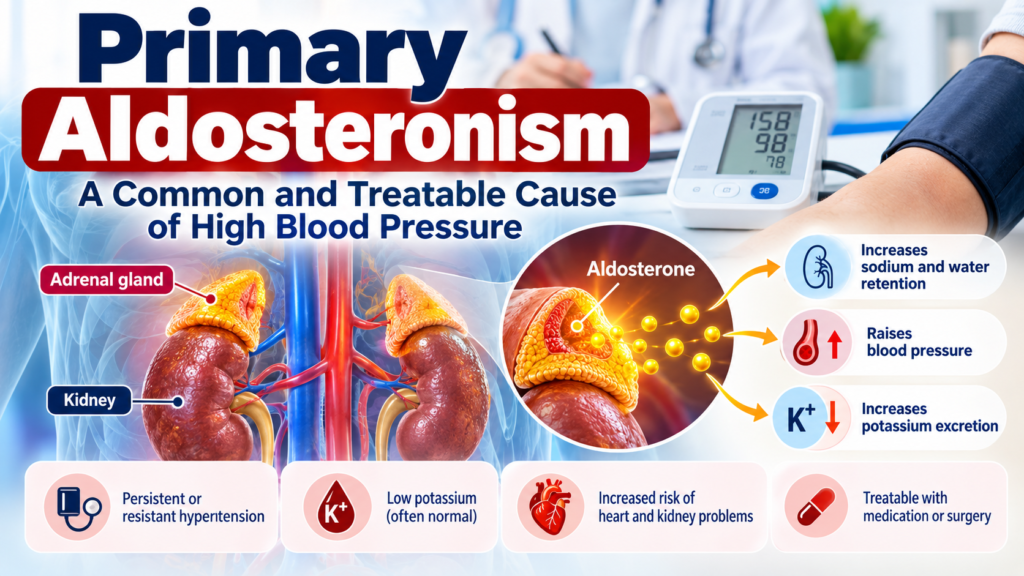
Primary aldosteronism (PA) is a potentially treatable cause of high blood pressure in which the adrenal glands produce too much aldosterone, a hormone that regulates sodium, potassium, and blood pressure.
Unlike ordinary hypertension, primary aldosteronism is caused by inappropriate aldosterone production rather than simply increased blood pressure from lifestyle or genetic factors. Early diagnosis is important because excessive aldosterone can increase the risk of stroke, heart disease, atrial fibrillation, kidney disease, and other cardiovascular complications.
What Is Aldosterone?
Aldosterone is produced by the adrenal glands, which are located above the kidneys.
Its main functions include:
- Increasing sodium and water retention
- Increasing potassium excretion
- Helping maintain blood volume and blood pressure
Normally, aldosterone production is regulated by the renin-angiotensin system and the body’s potassium level.
In primary aldosteronism, aldosterone production becomes inappropriate and remains elevated despite suppression of renin.
The typical biochemical pattern is:
High or inappropriately elevated aldosterone + suppressed renin → increased aldosterone-to-renin ratio (ARR)
What Causes Primary Aldosteronism?
The two major causes are:
1. Aldosterone-producing adrenal adenoma
A benign adrenal nodule produces excessive aldosterone. This is sometimes called Conn syndrome.
2. Bilateral adrenal hyperplasia
Both adrenal glands produce excessive aldosterone.
Other less common causes include:
- Unilateral adrenal hyperplasia
- Familial forms of primary aldosteronism
- Rare adrenal malignancy
The distinction between unilateral and bilateral disease is important because treatment may differ.
Who Should Be Evaluated for Primary Aldosteronism?
Primary aldosteronism should be considered particularly in patients with hypertension who have features suggesting secondary hypertension.
Examples include:
- Resistant hypertension
- Hypertension requiring several medications
- Hypertension with unexplained hypokalemia
- Hypertension with an adrenal incidentaloma
- Hypertension at a relatively young age
- Hypertension associated with obstructive sleep apnea
- Hypertension with a family history of early-onset hypertension or stroke
- Atrial fibrillation in the setting of hypertension
- Hypertension that is difficult to control despite appropriate treatment
Importantly, normal potassium does not exclude primary aldosteronism. Many patients with primary aldosteronism have normal serum potassium.
Symptoms of Primary Aldosteronism
Many patients have no specific symptoms other than hypertension.
Possible manifestations include:
- High blood pressure
- Headache
- Muscle weakness
- Muscle cramps
- Fatigue
- Excessive thirst
- Frequent urination
- Palpitations
Symptoms related to low potassium can occur in some patients, but hypokalemia is not present in every case.
Therefore, relying only on potassium levels can miss the diagnosis.
How Is Primary Aldosteronism Diagnosed?
Diagnosis generally involves several steps.
Step 1: Screening
The most commonly used screening test is the:
Aldosterone-to-Renin Ratio (ARR)
Blood samples are used to measure:
- Plasma aldosterone concentration
- Renin concentration or plasma renin activity
The ARR is then calculated.
A high ARR, particularly when renin is suppressed and aldosterone is inappropriately elevated, raises suspicion for primary aldosteronism.
However, ARR interpretation is affected by medications, potassium level, sodium intake, posture, time of day, and the specific laboratory assay.
Therefore, the ARR should not be interpreted in isolation.
Medications Can Affect the ARR
Several antihypertensive medications can alter aldosterone or renin levels.
Examples include:
- Beta-blockers
- ACE inhibitors
- ARBs
- Diuretics
- Mineralocorticoid receptor antagonists
- Some calcium-channel blockers
Medication adjustment before testing may be appropriate in selected patients, but this should be individualized.
Do not stop antihypertensive medications without medical supervision.
Correct Hypokalemia Before Testing
Low potassium can suppress aldosterone production and potentially produce misleading results.
If hypokalemia is present, potassium should generally be corrected before repeating or interpreting aldosterone testing.
Step 2: Confirmatory Testing
In patients with a positive screening test, additional testing may be used to confirm autonomous aldosterone secretion.
Depending on the clinical situation, confirmatory tests can include:
- Saline infusion test
- Oral sodium loading test
- Captopril challenge test
- Fludrocortisone suppression test
The choice depends on local expertise, patient characteristics, medication use, and safety considerations.
In certain patients with a very characteristic biochemical presentation, confirmatory testing may not always be necessary.
Step 3: Determine the Cause
Once primary aldosteronism has been established, the next question is:
Is aldosterone coming predominantly from one adrenal gland or from both?
Adrenal CT
A CT scan of the adrenal glands may identify:
- Adrenal adenoma
- Adrenal nodules
- Adrenal enlargement
- Other adrenal abnormalities
However, CT alone cannot reliably determine whether a visible adrenal nodule is responsible for aldosterone excess.
This is particularly important because non-functioning adrenal nodules become more common with increasing age.
Adrenal Vein Sampling
Adrenal vein sampling (AVS) is an important test for determining whether aldosterone secretion is predominantly unilateral or bilateral.
During AVS, blood samples are collected from the veins draining each adrenal gland and compared.
AVS can help determine whether a patient may benefit from unilateral adrenal surgery.
The procedure should generally be performed by an experienced center because it requires technical expertise.
Treatment of Primary Aldosteronism
Treatment depends mainly on whether the disease is unilateral or bilateral.
1. Unilateral Disease: Adrenalectomy
When primary aldosteronism is caused by unilateral adrenal aldosterone production, laparoscopic adrenalectomy may be considered.
Potential benefits include:
- Improved blood pressure control
- Reduction or resolution of hypokalemia
- Reduction in aldosterone excess
- Reduced need for antihypertensive medications in some patients
Blood pressure may not completely normalize after surgery, particularly in patients with long-standing hypertension or additional risk factors.
2. Bilateral Disease: Medical Therapy
For bilateral adrenal disease, treatment usually involves a mineralocorticoid receptor antagonist (MRA).
Common options include:
Spironolactone
Spironolactone blocks the mineralocorticoid receptor and reduces the effects of aldosterone.
Potential adverse effects include:
- Hyperkalemia
- Worsening renal function
- Gynecomastia
- Breast tenderness
- Menstrual disturbances in some patients
Eplerenone
Eplerenone is a more selective mineralocorticoid receptor antagonist and may cause fewer sex-hormone-related adverse effects than spironolactone.
However, it can be more expensive and may require twice-daily dosing depending on the clinical situation.
Treatment Goals
Treatment should address more than simply lowering blood pressure.
Important goals include:
- Control blood pressure
- Correct hypokalemia
- Block the harmful effects of excess aldosterone
- Reduce cardiovascular and renal risk
- Monitor kidney function and serum potassium
- Reduce unnecessary antihypertensive medication when appropriate
Aldosterone excess can have cardiovascular and renal effects beyond its effect on blood pressure, which is why recognizing and treating primary aldosteronism is important.
Follow-Up After Treatment
Patients treated for primary aldosteronism should have ongoing monitoring.
Depending on the treatment, clinicians may monitor:
- Blood pressure
- Serum potassium
- Serum creatinine/eGFR
- Aldosterone and renin when clinically appropriate
- Antihypertensive medication requirements
After starting or increasing an MRA, potassium and kidney function should be monitored appropriately.
Primary Aldosteronism and Resistant Hypertension
Primary aldosteronism is an important consideration in patients with resistant hypertension.
A patient whose blood pressure remains above target despite appropriate use of multiple antihypertensive medications may require evaluation for secondary causes.
Primary aldosteronism is particularly important because it is potentially treatable.
Identifying the condition may allow targeted treatment rather than simply adding more antihypertensive medications.
Primary Aldosteronism vs. Essential Hypertension
| Feature | Primary Aldosteronism | Essential Hypertension |
|---|---|---|
| Aldosterone | Inappropriately elevated | Usually appropriately regulated |
| Renin | Often suppressed | Variable |
| ARR | Often elevated | Usually not markedly elevated |
| Potassium | May be low or normal | Usually normal |
| Cause | Autonomous aldosterone production | Multifactorial |
| Specific treatment | Surgery or MRA in appropriate patients | Lifestyle + antihypertensive therapy |
| Potentially curable | Some unilateral cases | Usually requires long-term management |
When Should You See a Doctor?
Medical evaluation is especially important if you have:
- Difficult-to-control hypertension
- Hypertension requiring multiple medications
- Low potassium without an obvious cause
- An adrenal mass found incidentally
- Hypertension at a young age
- A family history of early hypertension or stroke
- Hypertension associated with atrial fibrillation
A doctor can determine whether screening for primary aldosteronism is appropriate.
Key Takeaways
Primary aldosteronism is an important and potentially treatable cause of hypertension.
Remember:
- Excess aldosterone causes sodium retention and potassium loss.
- Renin is typically suppressed.
- The aldosterone-to-renin ratio is an important screening test.
- Normal potassium does not exclude the diagnosis.
- Confirmatory testing may be required.
- Adrenal CT helps evaluate adrenal anatomy but does not by itself establish the source of aldosterone excess.
- Adrenal vein sampling may be needed to distinguish unilateral from bilateral disease.
- Unilateral disease may be treated with adrenalectomy.
- Bilateral disease is generally treated medically with a mineralocorticoid receptor antagonist.
- Blood pressure, potassium, and kidney function require appropriate follow-up.
If you have hypertension that is difficult to control, ask your doctor whether secondary hypertension—including primary aldosteronism—should be considered.
This article is for general educational purposes and does not replace an individual medical consultation. Diagnosis and treatment should be tailored to each patient’s clinical condition, medications, laboratory results, and kidney function.
Reference: The main clinical recommendations above are based on the 2025 Endocrine Society Clinical Practice Guideline on Primary Aldosteronism, published in the Journal of Clinical Endocrinology & Metabolism.