
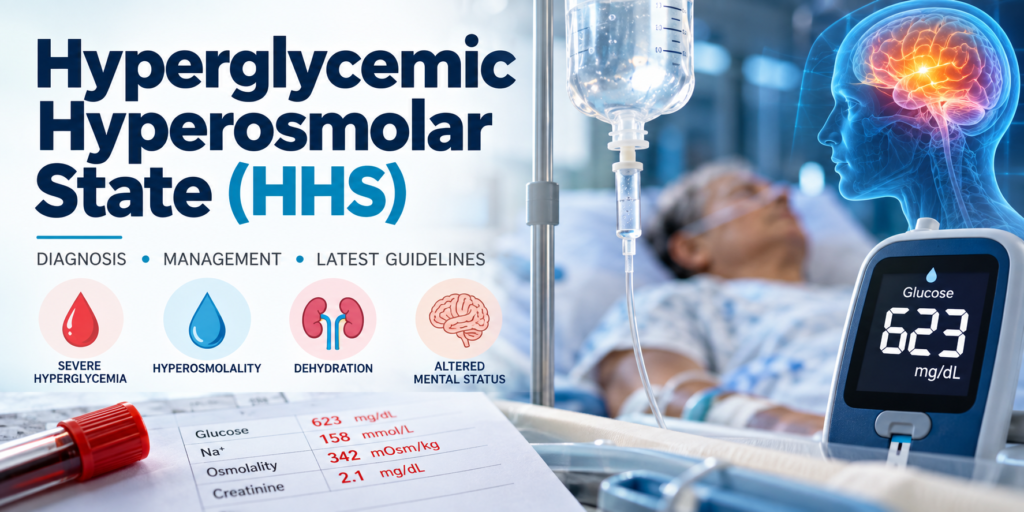
Hyperglycemic Hyperosmolar State (HHS) is a life-threatening diabetic emergency characterized by severe hyperglycemia, hyperosmolality, and profound dehydration. Learn the latest diagnostic criteria, treatment approach, complications, and prevention strategies based on current guidelines.
Hyperglycemic hyperosmolar state (HHS) is a life-threatening acute complication of diabetes characterized by severe hyperglycemia, hyperosmolality, and profound dehydration, usually without significant ketoacidosis. It is more commonly seen in older adults with type 2 diabetes, although it can occur in people with any type of diabetes.
HHS is a medical emergency requiring prompt recognition, careful fluid replacement, correction of electrolyte abnormalities, insulin therapy, and identification and treatment of the precipitating illness.
The current approach is based primarily on the ADA Standards of Care in Diabetes—2026 and the international consensus report on hyperglycemic crises in adults endorsed by the American Diabetes Association (ADA), European Association for the Study of Diabetes (EASD), Joint British Diabetes Societies (JBDS), American Association of Clinical Endocrinology (AACE), and Diabetes Technology Society (DTS).
What Is HHS?
HHS results from a relative deficiency of insulin combined with increased counter-regulatory hormones. There is usually enough endogenous insulin to suppress substantial ketone production, but not enough to prevent severe hyperglycemia.
Severe hyperglycemia causes osmotic diuresis, resulting in:
- Massive urinary water loss
- Sodium and electrolyte depletion
- Progressive dehydration
- Increased serum osmolality
- Reduced renal glucose clearance
- Worsening hyperglycemia
- Neurological dysfunction
HHS generally develops more gradually than diabetic ketoacidosis (DKA), often over several days to a week or longer.
Importantly, HHS and DKA are not completely separate disorders. Mixed DKA/HHS presentations are common, and approximately one-third of hyperglycemic emergencies may have overlapping features.
Diagnostic Criteria for HHS
According to the 2026 ADA Standards of Care, HHS requires four major components.
1. Severe hyperglycemia
Plasma glucose ≥600 mg/dL (≥33.3 mmol/L)
2. Hyperosmolality
Either:
Effective serum osmolality >300 mOsm/kg
or
Total serum osmolality >320 mOsm/kg
Effective osmolality can be calculated as:
Effective osmolality = 2 × Na⁺ + glucose (mmol/L)
Total osmolality can be calculated as:
Total osmolality = 2 × Na⁺ + glucose (mmol/L) + urea (mmol/L)
3. Absence of significant ketonemia
- β-hydroxybutyrate <3.0 mmol/L, or
- Urine ketones <2+
4. Absence of significant metabolic acidosis
- Venous or arterial pH ≥7.30
- Serum bicarbonate ≥15 mmol/L
All four components should be considered when establishing the diagnosis.
HHS vs DKA
| Feature | HHS | DKA |
|---|---|---|
| Typical diabetes | Usually type 2 | Usually type 1, but also type 2 |
| Onset | Days to weeks | Hours to days |
| Glucose | ≥600 mg/dL | ≥200 mg/dL or known diabetes |
| Hyperosmolality | Prominent | Variable |
| Ketones | Absent/mild | Markedly elevated |
| pH | ≥7.30 | <7.30 |
| Bicarbonate | ≥15 mmol/L | <18 mmol/L |
| Dehydration | Very severe | Moderate–severe |
| Mental status changes | Common | Variable |
| Abdominal pain/vomiting | Less common | Common |
| Kussmaul respiration | Usually absent | Common in severe DKA |
The distinction is clinically important, but patients can have mixed DKA/HHS, which generally carries a worse prognosis.
Common Precipitating Factors
HHS is frequently triggered by an acute illness or interruption of diabetes treatment.
Important precipitating factors include:
Infection
Common examples include:
- Pneumonia
- Urinary tract infection
- Sepsis
- Skin and soft-tissue infection
Infection is one of the most important precipitants of hyperglycemic crises.
Cardiovascular and cerebrovascular disease
Consider:
- Acute myocardial infarction
- Stroke
- Heart failure
- Other major cardiovascular stress
Other acute illnesses
- Pancreatitis
- Trauma
- Surgery
- Gastrointestinal illness
- Severe dehydration
Medication-related factors
Medications that may worsen hyperglycemia include:
- Glucocorticoids
- Some antipsychotic medications
- Other drugs that impair glucose metabolism
SGLT2 inhibitors are particularly important in relation to DKA, especially euglycemic DKA, although any patient presenting with a hyperglycemic crisis should have their medication history reviewed.
Inadequate diabetes treatment
HHS may occur because of:
- Missed medications
- Insufficient insulin therapy
- Newly diagnosed diabetes
- Poor access to medications
- Inadequate monitoring
- Cognitive impairment
- Difficulty obtaining food, fluids, insulin, or glucose-monitoring supplies
Clinical Presentation
HHS often develops more slowly than DKA.
Typical symptoms include:
- Polyuria
- Polydipsia
- Severe thirst
- Weakness
- Fatigue
- Weight loss
- Blurred vision
- Dehydration
- Dizziness
- Confusion
- Reduced consciousness
- Seizures in severe cases
- Coma
Physical findings may include:
- Tachycardia
- Hypotension
- Dry mucous membranes
- Poor skin turgor
- Weak peripheral pulses
- Altered mental status
- Reduced urine output in severe dehydration
Neurological abnormalities are particularly important. Changes in cognition are common in HHS and correlate with the degree of hyperosmolality.
Initial Evaluation
HHS should be treated as a medical emergency.
Initial assessment should include:
Bedside assessment
- Airway, breathing, circulation
- Mental status
- Vital signs
- Hydration status
- Fluid balance
- Urine output
- Weight when feasible
Laboratory investigations
Obtain:
- Plasma glucose
- Serum sodium
- Potassium
- Chloride
- Bicarbonate
- Urea
- Creatinine
- Serum osmolality
- β-hydroxybutyrate
- Venous blood gas
- CBC
- Magnesium
- Phosphate when clinically indicated
- HbA1c
Additional investigations should be directed toward identifying the precipitating cause.
Other investigations
Depending on clinical presentation:
- ECG
- Troponin
- Chest X-ray
- Blood cultures
- Urine analysis and culture
- Infection screening
- Brain imaging when indicated
- Additional cardiac or neurological investigations
The ECG is particularly useful because potassium abnormalities may cause potentially dangerous cardiac changes.
Monitoring During Treatment
During treatment:
Blood glucose
Check approximately every 1–2 hours.
Electrolytes and renal function
Repeat approximately every 4 hours, or more frequently when clinically indicated.
Serum osmolality
In HHS, serum osmolality should generally be monitored approximately every 4 hours during the acute phase.
Continuous assessment should include:
- Blood pressure
- Heart rate
- Respiratory status
- Neurological status
- Fluid input/output
- Urine output
- Signs of fluid overload
Management of HHS
The major treatment goals are:
- Restore circulating volume
- Correct dehydration
- Reduce hyperosmolality gradually
- Correct electrolyte abnormalities
- Control hyperglycemia
- Identify and treat the precipitating illness
- Prevent complications
The main therapeutic components are intravenous fluids, insulin, potassium/electrolyte replacement, and treatment of the underlying cause.
1. Fluid Replacement
Fluid therapy is the cornerstone of HHS management.
In adults without significant cardiac or renal compromise, current consensus guidance recommends starting:
0.9% sodium chloride or a balanced crystalloid at approximately 500–1,000 mL/hour during the first 2–4 hours.
The subsequent rate should be individualized according to:
- Blood pressure
- Heart rate
- Hydration status
- Sodium concentration
- Urine output
- Fluid balance
- Renal function
- Cardiac status
The estimated fluid deficit should generally be corrected over approximately 24–48 hours, rather than too rapidly.
Balanced crystalloids such as Ringer’s lactate may be useful and may reduce hyperchloremic metabolic acidosis compared with large-volume 0.9% saline.
Special caution
Older adults and patients with:
- Heart failure
- Advanced kidney disease
- Dialysis dependence
- Significant comorbidities
require more cautious fluid administration.
Smaller boluses, such as approximately 250 mL, with frequent reassessment may be appropriate in patients at high risk of fluid overload.
2. Avoid Rapid Correction of Hyperosmolality
One of the most important principles in HHS treatment is:
Do not correct glucose and osmolality too rapidly.
The recommended limits include:
- Glucose decline: ≤90–120 mg/dL/hour
- Sodium decline: ≤10 mmol/L per 24 hours
- Osmolality decline: approximately 3–8 mOsm/kg/hour
These limits are intended to reduce the risk of neurological complications.
A rise in serum sodium during the initial treatment of HHS does not automatically mean that hypotonic fluid should be started. As glucose falls, water shifts back into cells and serum sodium can rise.
If osmolality is not declining despite adequate fluid replacement and appropriate insulin therapy, 0.45% sodium chloride may be considered.
3. Intravenous Insulin
Insulin should be used carefully because fluids alone can produce a substantial reduction in glucose.
For HHS with:
- No significant ketosis, or
- Mild/moderate ketonemia
- No significant acidosis
the consensus recommendation is:
Regular/short-acting IV insulin infusion: 0.05 units/kg/hour.
If the patient has significant ketonemia or metabolic acidosis suggesting mixed DKA/HHS, use:
IV insulin infusion: 0.1 units/kg/hour.
Rapid-acting subcutaneous insulin regimens used for uncomplicated mild DKA are not recommended for HHS.
4. Potassium Management
Total-body potassium is usually depleted in HHS despite a normal or high initial serum potassium.
Insulin and correction of dehydration can cause serum potassium to fall rapidly.
Therefore:
- Monitor potassium closely.
- Replace potassium when indicated.
- Aim for serum potassium approximately 4–5 mmol/L.
- Potassium replacement is generally started when serum potassium falls below approximately 5.0 mmol/L, assuming adequate renal function and urine output.
If potassium is <3.5 mmol/L, potassium replacement should take priority and insulin should generally be delayed until potassium has been corrected to >3.5 mmol/L, because insulin can precipitate severe hypokalemia and potentially fatal arrhythmias.
5. Dextrose During Treatment
As plasma glucose falls, dextrose-containing fluids may eventually be necessary to prevent hypoglycemia while allowing insulin to continue when clinically required.
The exact glucose threshold and dextrose strategy should follow the institutional HHS protocol and the patient’s osmolality, neurological status, and insulin requirement.
The key principle is:
Do not stop treatment simply because glucose has normalized if significant hyperosmolality or other metabolic abnormalities remain.
6. Treatment of the Precipitating Cause
Correcting glucose alone is not sufficient.
Search actively for the underlying trigger.
If infection is suspected
- Obtain appropriate cultures.
- Start appropriate antimicrobial therapy when clinically indicated.
- Look for pneumonia, UTI, sepsis, skin infection, and other sources.
If myocardial infarction is suspected
Perform:
- ECG
- Cardiac biomarkers
- Appropriate cardiovascular assessment
If stroke is suspected
Perform urgent neurological assessment and appropriate brain imaging.
Other precipitating conditions should be treated according to standard emergency protocols.
7. Thrombosis Prevention
HHS is associated with significant dehydration and a prothrombotic state.
Unless contraindicated or thrombosis is already being treated, prophylactic-dose low-molecular-weight heparin is recommended for hospitalized patients to reduce thrombotic risk.
Patients with clinical evidence of venous or arterial thrombosis require full diagnostic evaluation and therapeutic anticoagulation when appropriate.
8. Level of Care
Because HHS is a serious hyperglycemic emergency, many patients require high-dependency or intensive monitoring.
ICU-level care should be strongly considered for:
- Altered mental status
- Hemodynamic instability
- Severe dehydration
- Significant electrolyte abnormalities
- Severe hyperosmolality
- Sepsis
- Myocardial infarction
- Stroke
- Significant renal dysfunction
- Respiratory compromise
- Other critical illness
The 2026 ADA Standards specifically identify HHS and severe hyperglycemic crises as conditions requiring appropriate high-level inpatient management.
When Is HHS Resolved?
There is not complete international agreement on a single definition of HHS resolution.
The international consensus report considers HHS resolved when:
- Serum osmolality is <300 mOsm/kg
- Hyperglycemia has been corrected
- Blood glucose is <250 mg/dL (13.9 mmol/L)
- Urine output is >0.5 mL/kg/hour
- Cognitive status has improved
Clinical recovery and normalization of the precipitating illness are also essential.
Major Complications
HHS itself and its treatment can cause serious complications.
Important complications include:
Neurological complications
- Cerebral edema
- Seizures
- Coma
- Neurological deterioration
- Osmotic demyelination syndrome
Rapid changes in serum osmolality should therefore be avoided.
Electrolyte abnormalities
- Hypokalemia
- Hyperkalemia
- Hyponatremia
- Hypernatremia
- Hypophosphatemia
- Hypomagnesemia
Cardiovascular complications
- Arrhythmias
- Myocardial ischemia
- Heart failure
- Pulmonary edema from excessive fluid administration
Renal complications
Acute kidney injury is common and often improves with restoration of renal perfusion and hydration.
Thromboembolic complications
- Deep vein thrombosis
- Pulmonary embolism
- Arterial thrombosis
Treatment-related complications
- Hypoglycemia
- Hypokalemia
- Fluid overload
- Hyperchloremic metabolic abnormalities
Prevention of HHS
Prevention is an important component of diabetes management.
Patients and caregivers should be educated about:
- Maintaining adequate hydration during illness
- Monitoring glucose more frequently during acute illness
- Recognizing symptoms of severe hyperglycemia
- Taking diabetes medications according to an individualized sick-day plan
- Recognizing infection early
- Seeking medical attention for persistent severe hyperglycemia
- Avoiding interruption of essential insulin therapy without medical advice
- Having access to glucose-monitoring equipment and medications
The ADA 2026 Standards recommend structured education about recognition, prevention, and management of hyperglycemic crises for patients at increased risk.
Social and economic barriers should also be assessed, including difficulty obtaining insulin, medications, glucose-monitoring equipment, or healthcare.
Key Clinical Pearls
1. HHS is an emergency
Severe hyperglycemia with dehydration and altered mental status should immediately raise suspicion for HHS.
2. Fluids are the foundation of treatment
Restoration of circulating volume improves renal perfusion and helps lower glucose and osmolality.
3. Do not lower osmolality too quickly
The goal is controlled correction rather than rapid normalization.
4. Check potassium before giving insulin
Insulin can rapidly lower serum potassium.
5. Always look for the precipitating cause
Infection, myocardial infarction, stroke, medications, and inadequate diabetes treatment are important triggers.
6. Think about mixed DKA/HHS
Significant ketonemia or metabolic acidosis means the patient may have a mixed hyperglycemic crisis and requires the corresponding DKA insulin strategy.
7. Older patients require special attention
Older adults frequently have cardiovascular and renal comorbidities, making aggressive fluid replacement potentially dangerous.
8. HHS does not end when glucose normalizes
Osmolality, neurological status, hydration, renal function, and the underlying precipitating condition must also improve.
Practical HHS Treatment Algorithm
Suspected HHS
↓
Confirm diagnosis
Glucose ≥600 mg/dL
- Hyperosmolality
- No significant ketosis
- No significant acidosis
↓
Assess ABC + neurological status + hemodynamics
↓
Start IV isotonic crystalloid
Usually 500–1,000 mL/hour initially in patients without cardiac/renal compromise
↓
Check potassium
- K⁺ <3.5 mmol/L: replace potassium; delay insulin
- K⁺ 3.5–5.0 mmol/L: replace potassium as needed
- K⁺ >5.0 mmol/L: monitor closely; start insulin when appropriate
↓
IV insulin
HHS without significant ketosis/acidosis:
0.05 units/kg/hour
Mixed DKA/HHS:
0.1 units/kg/hour
↓
Monitor every 1–4 hours
Glucose
Electrolytes
Renal function
Serum osmolality
Urine output
Neurological status
↓
Control rate of correction
Glucose fall ≤90–120 mg/dL/hour
Osmolality fall 3–8 mOsm/kg/hour
Sodium fall ≤10 mmol/L/24 hours
↓
Treat precipitating illness
Infection / MI / stroke / medication / dehydration / other acute illness
↓
Continue until HHS resolves
Osmolality <300 mOsm/kg
Glucose <250 mg/dL
Urine output >0.5 mL/kg/hour
Cognition improved
↓
Transition to long-term diabetes management
Education + medication optimization + follow-up + prevention plan
Frequently Asked Questions
1. What glucose level defines HHS?
The current ADA diagnostic threshold is plasma glucose ≥600 mg/dL (≥33.3 mmol/L) together with hyperosmolality and absence of significant ketosis and acidosis.
2. Can HHS occur in type 1 diabetes?
Yes. HHS is more common in type 2 diabetes, particularly older adults, but it can occur in people with type 1 diabetes and other forms of diabetes.
3. Is HHS more dangerous than DKA?
HHS carries a substantial risk of morbidity and mortality. Historically, mortality has been considerably higher than for uncomplicated DKA, partly because patients with HHS are often older and have serious precipitating illnesses.
4. Can HHS and DKA occur together?
Yes. Mixed DKA/HHS is common. Significant ketonemia or metabolic acidosis in a patient with HHS should prompt treatment as a mixed hyperglycemic crisis.
5. Should insulin be given immediately in HHS?
Insulin is important, but fluid replacement should begin promptly and the rate of glucose/osmolality decline must be controlled. For uncomplicated HHS without significant ketosis or acidosis, IV insulin is generally started at 0.05 units/kg/hour after initial assessment and fluid therapy.
6. Why can sodium rise during HHS treatment?
As glucose falls, water shifts from the extracellular to intracellular compartment. Consequently, measured serum sodium may rise even while the patient’s overall hydration and osmolality are improving. A sodium rise alone is not an automatic indication for hypotonic fluid.
7. When should 0.45% saline be used?
The consensus report recommends considering 0.45% sodium chloride when serum osmolality is not declining despite adequate positive fluid balance and appropriate insulin therapy, rather than simply because serum sodium initially rises.
8. Why is potassium so important?
Total-body potassium is usually depleted because of osmotic diuresis. Insulin drives potassium into cells, potentially causing severe hypokalemia and arrhythmias. Potassium must therefore be monitored and replaced appropriately.
9. Can HHS be treated at home?
No. Suspected HHS requires urgent hospital evaluation and treatment because patients may have profound dehydration, electrolyte abnormalities, hyperosmolality, neurological impairment, and a serious precipitating illness. The ADA specifically recommends inpatient evaluation and treatment for suspected HHS.
10. How can HHS be prevented?
Prevention includes good long-term glycemic control, medication adherence, adequate hydration during illness, appropriate sick-day planning, early recognition and treatment of infection, glucose monitoring, and timely medical assessment when severe hyperglycemia or altered mental status develops.
Conclusion
Hyperglycemic hyperosmolar state is a life-threatening diabetic emergency characterized by severe hyperglycemia, hyperosmolality, and profound dehydration with little or no significant ketoacidosis.
Early recognition is essential. Management should prioritize careful intravenous fluid replacement, controlled correction of hyperosmolality, appropriate IV insulin, potassium and electrolyte management, thrombosis prevention, and aggressive identification and treatment of the precipitating illness.
The most important principle is to avoid overly rapid correction. In HHS, the goal is not simply to normalize glucose quickly—it is to restore perfusion and gradually correct hyperosmolality while preventing neurological and electrolyte complications.
Patients who survive HHS should receive a comprehensive discharge plan addressing diabetes treatment, medication access, sick-day management, glucose monitoring, education, and follow-up to reduce the risk of recurrence.
References
- American Diabetes Association Professional Practice Committee. 6. Glycemic Goals, Hypoglycemia, and Hyperglycemic Crises: Standards of Care in Diabetes—2026. Diabetes Care. 2026;49(Suppl 1):S132-S149. doi:10.2337/dc26-S006.
- American Diabetes Association Professional Practice Committee. 16. Diabetes Care in the Hospital: Standards of Care in Diabetes—2026. Diabetes Care. 2026;49(Suppl 1):S339-S367.
- Umpierrez GE, Davis GM, ElSayed NA, et al. Hyperglycemic Crises in Adults With Diabetes: A Consensus Report. Diabetes Care. 2024;47(8):1257-1275. doi:10.2337/dci24-0032.
- Umpierrez GE, Korytkowski M. Diabetic emergencies—ketoacidosis, hyperglycaemic hyperosmolar state and hypoglycaemia. Nat Rev Endocrinol. 2016;12:222-232.
- Dhatariya KK, Joint British Diabetes Societies for Inpatient Care. The Management of Hyperosmolar Hyperglycaemic State (HHS) in Adults with Diabetes. JBDS guideline.
Clinical disclaimer: This article is intended for medical education and should not replace individual clinical assessment, institutional protocols, or specialist consultation. HHS is a medical emergency requiring hospital-based management.