
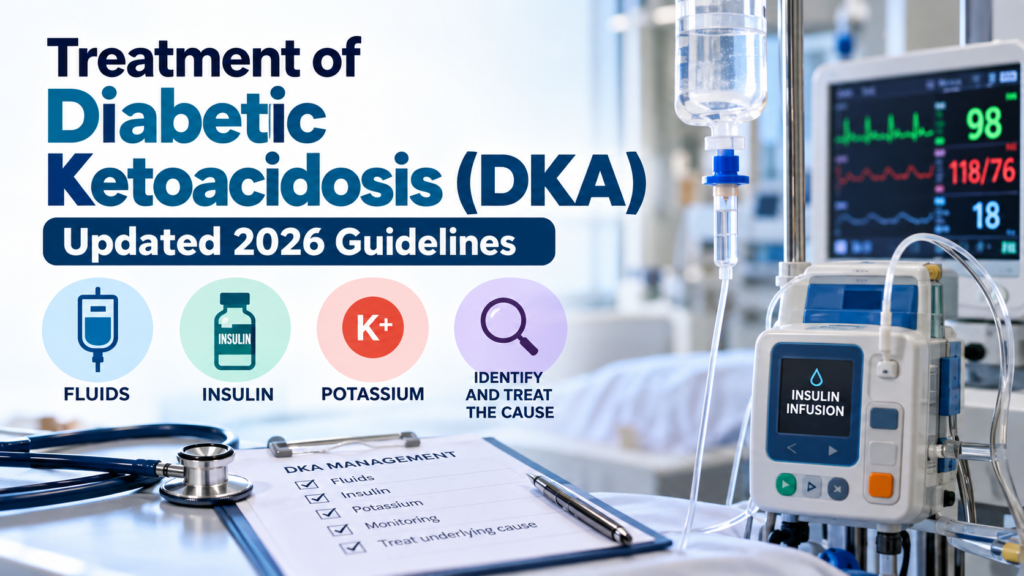
Diabetic ketoacidosis (DKA) is a life-threatening complication of diabetes that requires rapid diagnosis and treatment. This updated guide explains the latest approach to DKA treatment, including intravenous fluids, insulin therapy, potassium replacement, dextrose administration, monitoring, resolution criteria, and transition to subcutaneous insulin.
Diabetic ketoacidosis (DKA) is a serious and potentially life-threatening acute complication of diabetes characterized by ketosis, metabolic acidosis, and diabetes/hyperglycemia. Although DKA is most commonly associated with type 1 diabetes, it can also occur in people with type 2 diabetes, particularly during acute illness, insulin deficiency, or treatment with sodium-glucose cotransporter-2 (SGLT2) inhibitors.
DKA requires prompt recognition, intravenous fluid replacement, insulin therapy, careful potassium and electrolyte management, identification and treatment of the precipitating cause, and close monitoring.
The recommendations below are based mainly on the 2024 international consensus report from the American Diabetes Association (ADA), European Association for the Study of Diabetes (EASD), Joint British Diabetes Societies (JBDS), American Association of Clinical Endocrinology (AACE), and Diabetes Technology Society (DTS), together with the ADA Standards of Care 2026 and more recent literature. (PubMed)
Important: DKA is a medical emergency. This article is intended for healthcare professionals and patient education and should not replace local hospital protocols or specialist clinical judgment.
What Is Diabetic Ketoacidosis?
DKA develops when there is insufficient effective insulin activity together with increased counter-regulatory hormones such as glucagon, catecholamines, cortisol, and growth hormone.
The resulting metabolic abnormalities include:
- Increased lipolysis
- Increased free fatty acid delivery to the liver
- Increased ketone production
- Metabolic acidosis
- Hyperglycemia
- Osmotic diuresis
- Dehydration
- Electrolyte depletion
Importantly, total-body potassium is usually depleted, even when the initial serum potassium is normal or elevated.
Diagnostic Criteria for DKA
The 2024 consensus and ADA Standards of Care 2026 use three major components for diagnosis:
1. Diabetes or hyperglycemia
Either:
- Plasma glucose ≥200 mg/dL (11.1 mmol/L), or
- A previous diagnosis of diabetes
2. Ketosis
- β-hydroxybutyrate ≥3.0 mmol/L
or
- Urine ketones ≥2+
3. Metabolic acidosis
- Venous or arterial pH <7.30 and/or
- Serum bicarbonate <18 mmol/L
(DOI)
Euglycemic DKA
DKA does not always present with marked hyperglycemia.
Approximately 10% of DKA episodes may occur with glucose <200 mg/dL (11.1 mmol/L). This is called euglycemic DKA.
Important causes include:
- SGLT2 inhibitors
- Reduced carbohydrate intake
- Prolonged fasting
- Pregnancy
- Alcohol use
- Severe acute illness
- Reduced insulin administration
Therefore, a relatively normal glucose level does not exclude DKA when significant ketonemia and metabolic acidosis are present. (DOI)
Assess the Severity of DKA
DKA can be classified as mild, moderate, or severe.
| Parameter | Mild | Moderate | Severe |
|---|---|---|---|
| β-hydroxybutyrate | 3–6 mmol/L | 3–6 mmol/L | >6 mmol/L |
| pH | 7.25–<7.30 | 7.00–7.25 | <7.00 |
| Bicarbonate | 15–18 mmol/L | 10–<15 mmol/L | <10 mmol/L |
| Mental status | Alert | Alert/drowsy | Stupor/coma |
| Typical level of care | Ward/observation | Step-down/intermediate | ICU |
(DOI)
The severity of DKA, hemodynamic instability, altered mental status, major electrolyte abnormalities, and underlying comorbidities should determine the appropriate level of monitoring.
Initial Assessment
When DKA is suspected, treatment and diagnostic evaluation should proceed simultaneously.
Initial investigations
Recommended investigations include:
- Capillary or plasma glucose
- Serum electrolytes
- Sodium
- Potassium
- Chloride
- Bicarbonate
- Urea and creatinine
- Venous blood gas
- β-hydroxybutyrate
- Complete blood count
- Serum osmolality when indicated
- Urinalysis
- ECG
- Infection investigations when clinically indicated
Additional investigations should be guided by the suspected precipitating cause.
Identify the Precipitating Cause
Treatment of DKA is incomplete unless the underlying trigger is identified and treated.
Common precipitating factors include:
Infection
Examples:
- Pneumonia
- Urinary tract infection
- Sepsis
- Skin/soft-tissue infection
Insulin omission or inadequate insulin
This is particularly important in patients using insulin pumps or basal-bolus insulin therapy.
New-onset diabetes
DKA may be the first presentation of diabetes.
Acute cardiovascular disease
- Myocardial infarction
- Stroke
Other triggers
- Pancreatitis
- Surgery
- Trauma
- Severe physiological stress
- Corticosteroid therapy
- Certain medications
SGLT2 inhibitors
SGLT2 inhibitors such as empagliflozin, dapagliflozin, and canagliflozin can precipitate euglycemic DKA.
The Three Main Principles of DKA Treatment
Treatment can be remembered as:
FLUIDS + INSULIN + POTASSIUM
At the same time:
Treat the precipitating cause.
1. Intravenous Fluid Replacement
Fluid replacement is one of the first and most important interventions.
DKA causes substantial water and electrolyte losses through osmotic diuresis.
Initial fluid therapy
For adults without significant cardiac or renal impairment:
- 0.9% sodium chloride or
- A balanced crystalloid such as lactated Ringer’s solution or Plasma-Lyte
may be used.
The 2024 consensus recommends approximately:
500–1,000 mL/hour during the first 2–4 hours
with subsequent fluid therapy individualized according to:
- Blood pressure
- Heart rate
- Hydration status
- Urine output
- Serum sodium
- Fluid balance
- Cardiac function
- Renal function
(DOI)
Balanced crystalloids have become increasingly attractive because studies suggest faster DKA resolution and less hyperchloremic metabolic acidosis compared with large-volume normal saline administration. (DOI)
Use caution in:
- Older adults
- Heart failure
- Chronic kidney disease
- Pregnancy
- Frail patients
These patients may require smaller fluid volumes and closer monitoring to avoid pulmonary edema and fluid overload. (PubMed Central (PMC))
2. Insulin Therapy
Insulin is essential because it stops ketogenesis and corrects the underlying metabolic abnormality.
For moderate or severe DKA, the usual treatment is:
Intravenous regular insulin
0.1 units/kg/hour by continuous IV infusion
An IV insulin bolus is generally not necessary when the infusion can be started promptly. A bolus may be considered in selected protocols when there is a delay in establishing the infusion.
Insulin should be started after initial fluid resuscitation and after confirming that potassium is not dangerously low.
When Should Insulin Be Delayed?
Potassium <3.5 mmol/L
Do not start insulin immediately.
Insulin will shift potassium intracellularly and may precipitate severe hypokalemia and potentially life-threatening arrhythmias.
Instead:
- Begin potassium replacement.
- Monitor potassium closely.
- Start insulin once potassium is safely corrected.
This is one of the most important safety principles in DKA management.
What Happens When Glucose Falls?
A common mistake is to stop insulin when glucose normalizes.
The purpose of insulin in DKA is not simply to lower glucose—it is to stop ketogenesis and resolve ketoacidosis.
Blood glucose commonly falls below 250 mg/dL (13.9 mmol/L) before ketoacidosis has resolved.
Therefore, once glucose falls below approximately:
250 mg/dL (13.9 mmol/L)
add:
5–10% dextrose
to the IV fluids and continue insulin.
This allows insulin therapy to continue until ketonemia and acidosis resolve without causing hypoglycemia. (PubMed Central (PMC))
3. Potassium Replacement
Potassium management is critical because DKA causes a substantial total-body potassium deficit.
Although serum potassium may initially be normal or high, total-body potassium is usually depleted.
Insulin therapy causes potassium to move into cells, potentially causing rapid hypokalemia.
General approach
| Serum K⁺ | Management |
|---|---|
| <3.5 mmol/L | Hold insulin; replace potassium first |
| 3.5–5.0 mmol/L | Add potassium to IV fluids according to serum level and urine output |
| >5.0 mmol/L | Usually no potassium initially; monitor closely |
The goal during treatment is generally to maintain serum potassium around:
4.0–5.0 mmol/L
Adequate renal function and urine output should be confirmed before potassium replacement.
Potassium should be checked frequently during active treatment. (Diabetes UK)
Phosphate Replacement
Routine phosphate replacement is not recommended.
Although total-body phosphate is frequently depleted, routine replacement has not demonstrated clear clinical benefit.
Phosphate replacement may be considered when there is:
- Significant hypophosphatemia
- Muscle weakness
- Respiratory compromise
- Cardiac dysfunction
Replacement should be individualized.
4. Bicarbonate Therapy
Routine bicarbonate administration is not recommended for most patients with DKA.
Why?
Bicarbonate therapy has not consistently demonstrated improved DKA resolution and may cause complications such as:
- Hypokalemia
- Sodium/fluid overload
- Paradoxical intracellular acidosis
- Potential neurologic complications
Current guidance generally reserves bicarbonate for severe acidemia, typically when:
pH <7.0
rather than routine treatment of DKA. (Diabetes UK)
5. Monitoring During DKA Treatment
DKA requires frequent reassessment.
Monitor:
Blood glucose
Usually every 1–2 hours during IV insulin therapy.
Electrolytes
Monitor:
- Sodium
- Potassium
- Chloride
- Bicarbonate
Renal function
Monitor:
- Urea
- Creatinine
- Urine output
Ketones
Blood β-hydroxybutyrate is preferable when available.
Acid-base status
Venous pH and bicarbonate can be followed to assess resolution.
The consensus approach recommends frequent laboratory reassessment, commonly every 2–4 hours, until the patient is clinically and metabolically stable. (Diabetes UK)
How Do We Know DKA Has Resolved?
The 2024 consensus emphasizes direct assessment of ketone clearance rather than relying solely on the anion gap.
A practical resolution target is:
- β-hydroxybutyrate <0.6 mmol/L
- Venous pH ≥7.3 or
- Bicarbonate ≥18 mmol/L
together with clinical improvement and ability to transition safely to subcutaneous insulin. (Diabetes UK)
Why not rely only on the anion gap?
The anion gap can remain elevated because of other processes and may also be affected by hyperchloremic metabolic acidosis caused by large-volume normal saline administration.
Therefore, blood β-hydroxybutyrate is a more direct marker of ketone clearance when available.
6. Transition From IV to Subcutaneous Insulin
One of the most important steps is preventing recurrent DKA after stopping the insulin infusion.
Once:
- Ketoacidosis has resolved
- The patient is clinically stable
- The patient can eat and drink
- A subcutaneous insulin regimen has been established
transition to subcutaneous insulin.
Basal-bolus insulin is preferred
The patient should receive basal insulin before stopping the IV insulin infusion.
The consensus report recommends administering subcutaneous insulin approximately:
1–2 hours before discontinuing IV insulin
to prevent rebound hyperglycemia and recurrent ketosis. (PubMed)
Some hospital protocols use a longer overlap period, particularly when using specific basal insulin strategies.
7. Mild DKA and Subcutaneous Insulin
Selected patients with uncomplicated mild DKA may be treated with subcutaneous rapid-acting insulin analogues rather than continuous IV insulin.
This approach requires:
- Adequate fluid replacement
- Frequent glucose monitoring
- Frequent clinical assessment
- Reliable nursing supervision
- No major hemodynamic instability
- No severe acidosis or altered mental status
Subcutaneous rapid-acting insulin should not be used as the primary treatment for severe or complicated DKA. (SER Diabète IDF)
Euglycemic DKA: An Important Special Situation
Euglycemic DKA is particularly important with SGLT2 inhibitors.
The glucose may be:
- Normal
- Mildly elevated
- <200 mg/dL
while significant ketoacidosis is present.
Treatment is still based on:
Fluid + insulin + potassium + dextrose when necessary
Because glucose is not markedly elevated, dextrose may need to be started early or at the same time as insulin to allow adequate insulin administration until ketosis resolves. (Diabetes UK)
The suspected SGLT2 inhibitor should be stopped.
DKA in Patients With Heart or Kidney Disease
Standard aggressive fluid replacement may be dangerous in patients with:
- Heart failure
- Advanced chronic kidney disease
- Dialysis dependence
- Significant fluid overload
These patients require individualized fluid administration with frequent assessment of:
- Blood pressure
- Lung examination
- Oxygenation
- Urine output
- Fluid balance
- Renal function
- Electrolytes
Smaller fluid boluses and closer hemodynamic monitoring may be appropriate.
DKA During Pregnancy
DKA can develop at lower glucose concentrations during pregnancy.
Pregnancy is also associated with a higher risk of euglycemic DKA.
Management requires urgent multidisciplinary care involving:
- Obstetrics
- Endocrinology/diabetes
- Critical care when necessary
Maternal stabilization is the immediate priority, with continuous assessment of fetal status according to gestational age and clinical circumstances.
DKA and SGLT2 Inhibitors
Healthcare professionals should maintain a high index of suspicion for DKA in patients taking:
- Empagliflozin
- Dapagliflozin
- Canagliflozin
- Ertugliflozin
Risk may increase during:
- Prolonged fasting
- Acute illness
- Surgery
- Dehydration
- Reduced insulin administration
- Very-low-carbohydrate diets
Patients should receive appropriate sick-day education and be instructed when these medications should be temporarily withheld according to current clinical guidance and local protocols.
Common Mistakes in DKA Management
1. Stopping insulin when glucose normalizes
Glucose normalization does not necessarily mean ketoacidosis has resolved.
Continue insulin and add dextrose.
2. Starting insulin when potassium is severely low
This can cause dangerous hypokalemia.
Correct potassium first.
3. Giving bicarbonate routinely
Routine bicarbonate does not improve most cases of DKA.
Reserve it for severe acidemia according to guideline criteria.
4. Treating glucose instead of ketoacidosis
The therapeutic endpoint is resolution of ketogenesis and metabolic acidosis—not simply normalization of glucose.
5. Stopping IV insulin without basal insulin overlap
This can cause rebound hyperglycemia and recurrent DKA.
6. Failing to identify the trigger
DKA may recur if infection, insulin omission, myocardial infarction, medication-related causes, or other precipitating factors are not addressed.
Practical DKA Treatment Algorithm
Step 1 — Confirm DKA
Check:
Glucose + β-hydroxybutyrate + pH/bicarbonate
Also assess:
- Vital signs
- Mental status
- Hydration
- Electrolytes
- Renal function
- Precipitating cause
↓
Step 2 — Start IV fluids
Use:
0.9% saline or balanced crystalloid
Typically:
500–1,000 mL/hour for the first 2–4 hours
if no cardiac or renal contraindication.
↓
Step 3 — Check potassium
K⁺ <3.5 mmol/L
Hold insulin and replace potassium.
K⁺ 3.5–5.0 mmol/L
Start insulin and give potassium as appropriate.
K⁺ >5.0 mmol/L
Start insulin without initial potassium and monitor closely.
↓
Step 4 — Start insulin
Usually:
Regular insulin IV 0.1 units/kg/hour
↓
Step 5 — When glucose <250 mg/dL
Add:
5–10% dextrose
and continue insulin.
↓
Step 6 — Continue until ketoacidosis resolves
Follow:
- β-hydroxybutyrate
- pH
- Bicarbonate
- Potassium
- Glucose
- Clinical status
↓
Step 7 — Transition to subcutaneous insulin
Give basal insulin before stopping IV insulin.
↓
Step 8 — Treat the precipitating cause and prevent recurrence
Provide:
- Sick-day education
- Insulin education
- Ketone monitoring education when appropriate
- Medication review
- Follow-up
Prevention of Recurrent DKA
Preventing another episode is an essential part of DKA management.
Patients should understand:
During illness
- Continue appropriate insulin unless specifically instructed otherwise.
- Monitor glucose more frequently.
- Monitor ketones when indicated.
- Maintain hydration.
- Seek medical attention early if vomiting, abdominal pain, rapid breathing, or persistent hyperglycemia/ketosis develops.
Review insulin technique
Check:
- Injection technique
- Insulin storage
- Insulin supply
- Adherence
- Injection sites
- Insulin pump function if applicable
Review medications
Particular attention should be paid to SGLT2 inhibitors and other medications that may contribute to dehydration or ketosis.
Frequently Asked Questions About DKA
1. Is DKA only seen in type 1 diabetes?
No.
Although DKA is common in type 1 diabetes, it can also occur in people with type 2 diabetes, especially during severe illness, insulin deficiency, or exposure to precipitating medications such as SGLT2 inhibitors.
2. Can DKA occur with normal blood glucose?
Yes.
This is called euglycemic DKA.
It is particularly important in patients taking SGLT2 inhibitors, as well as during fasting, pregnancy, reduced carbohydrate intake, and some acute illnesses.
3. What is the most important treatment for DKA?
There are three fundamental treatments:
Fluid replacement + insulin + potassium management.
The precipitating cause must also be identified and treated.
4. When should insulin be started?
Insulin should generally be started promptly after initial assessment and fluid therapy, provided potassium is not dangerously low.
If potassium is <3.5 mmol/L, insulin should generally be withheld temporarily while potassium is replaced.
5. Should insulin be stopped when glucose reaches 200–250 mg/dL?
No.
Ketoacidosis may still be present.
Dextrose should be added to the IV fluid so that insulin can continue until ketonemia and acidosis resolve.
6. Should bicarbonate be routinely given?
No.
Routine bicarbonate therapy is not recommended.
It may be considered in severe acidemia, generally when pH <7.0, according to current consensus recommendations. (Diabetes UK)
7. How frequently should potassium be checked?
Potassium should be monitored frequently during active treatment, particularly after starting insulin because insulin can rapidly lower serum potassium.
The exact frequency should follow the severity of DKA and the hospital protocol.
8. When can IV insulin be stopped?
IV insulin should generally be continued until ketoacidosis has resolved and the patient is ready for subcutaneous insulin.
A commonly used resolution target is:
- β-hydroxybutyrate <0.6 mmol/L
- pH ≥7.3 or bicarbonate ≥18 mmol/L
with clinical improvement.
9. Why is basal insulin given before stopping IV insulin?
Because IV insulin has a very short duration of action.
If it is stopped before adequate subcutaneous basal insulin is active, insulin deficiency can recur rapidly, resulting in rebound hyperglycemia and recurrent ketoacidosis.
10. Can mild DKA be treated without an IV insulin infusion?
Selected patients with uncomplicated mild DKA may be treated with subcutaneous rapid-acting insulin under an appropriate protocol and close monitoring.
However, severe DKA, complicated DKA, hemodynamic instability, altered consciousness, or significant comorbidity generally requires IV insulin and higher-acuity monitoring.
Key Take-Home Messages
1. DKA is a medical emergency.
2. Diagnose DKA using hyperglycemia/diabetes + ketonemia + metabolic acidosis.
3. Do not exclude DKA because glucose is not very high.
4. Start appropriate IV fluid replacement promptly.
5. Insulin stops ketogenesis and is the cornerstone of therapy.
6. Always check potassium before and during insulin therapy.
7. If potassium is severely low, replace potassium before starting insulin.
8. When glucose falls below approximately 250 mg/dL, add 5–10% dextrose rather than stopping insulin.
9. Do not routinely use bicarbonate.
10. Follow β-hydroxybutyrate and acid-base status to determine resolution.
11. Give subcutaneous basal insulin before discontinuing IV insulin.
12. Always identify and treat the precipitating cause.
13. Patients taking SGLT2 inhibitors can develop euglycemic DKA.
Early recognition, standardized treatment protocols, careful electrolyte monitoring, and appropriate transition to subcutaneous insulin can substantially improve the safety of DKA management.
References
- Umpierrez GE, Davis GM, ElSayed NA, et al. Hyperglycemic Crises in Adults With Diabetes: A Consensus Report. Diabetes Care. 2024;47(8):1257–1275. doi:10.2337/dci24-0032. (PubMed)
- Umpierrez GE, Davis GM, ElSayed NA, et al. Hyperglycaemic crises in adults with diabetes: a consensus report. Diabetologia. 2024;67:1455–1479. doi:10.1007/s00125-024-06183-8. (PubMed)
- American Diabetes Association Professional Practice Committee. 16. Diabetes Care in the Hospital: Standards of Care in Diabetes—2026. Diabetes Care. 2026. (PubMed)
- Resl M, Kaser S, Sourij H, et al. Treatment of acute diabetic metabolic crises in adults (Update 2026). Wien Klin Wochenschr. 2026;138(Suppl 4):303–307. doi:10.1007/s00508-025-02694-5. (PubMed)
- Feingold KR, Dhatariya K. Diabetic Ketoacidosis. Endotext. Updated 2026. National Center for Biotechnology Information. (NCBI)
- Ciafardini A, Vena W, Betella N, et al. Diabetic Ketoacidosis: Considerations and Residual Controversies in Management After the 2024 ADA, EASD, JBDS, AACE, and DST Joint Consensus. 2026. (PubMed)
Disclaimer: This article is intended for general medical education and healthcare professionals. DKA is a medical emergency requiring urgent hospital assessment and treatment. Management should be individualized according to the patient’s clinical condition, comorbidities, laboratory results, and local hospital protocols.