
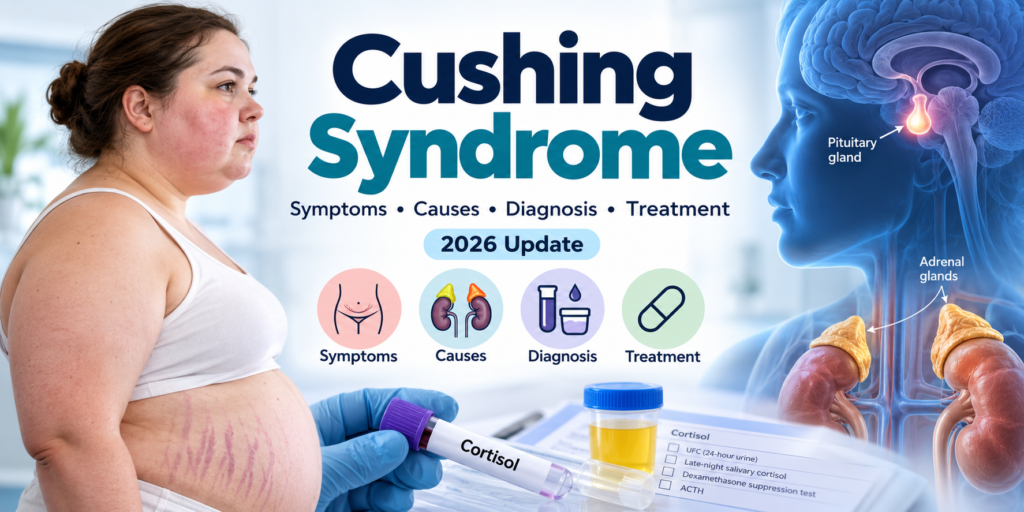
Cushing syndrome (CS) is a clinical disorder caused by prolonged exposure to excessive cortisol. It can affect almost every organ system and is associated with important complications including hypertension, diabetes, cardiovascular disease, osteoporosis, infections, psychiatric symptoms and venous thromboembolism.
Cushing syndrome is uncommon and can be difficult to recognize because many of its features overlap with common conditions such as obesity, hypertension, type 2 diabetes and depression. Early recognition and appropriate biochemical testing are therefore important.
The management of Cushing syndrome has also evolved considerably, with advances in pituitary surgery, cortisol-lowering medications, radiotherapy and individualized biochemical monitoring.
This article summarizes the current approach to Cushing syndrome based on major international guidance and recent 2025–2026 consensus updates.
What Is Cushing Syndrome?
Cushing syndrome occurs when the body is exposed to excessive glucocorticoid activity for a prolonged period.
There are two broad categories:
1. Exogenous or iatrogenic Cushing syndrome
This is caused by prolonged treatment with glucocorticoid medications such as:
- Prednisone
- Prednisolone
- Dexamethasone
- Methylprednisolone
- Hydrocortisone
Glucocorticoids may be administered orally, intravenously, intra-articularly, inhaled, or sometimes through other routes.
A careful medication history is therefore essential before starting an endocrine investigation. (Endocrine Society)
2. Endogenous Cushing syndrome
This occurs when the body produces excessive cortisol.
Endogenous Cushing syndrome can be divided according to ACTH:
ACTH-dependent Cushing syndrome
- Pituitary ACTH-producing adenoma → Cushing disease
- Ectopic ACTH production → usually from neuroendocrine tumors
ACTH-independent Cushing syndrome
- Adrenal cortisol-producing adenoma
- Adrenocortical carcinoma
- Bilateral adrenal hyperplasia or other rare adrenal disorders
Cushing Syndrome vs Cushing Disease
These terms are often confused.
Cushing syndrome describes the clinical state caused by excessive cortisol exposure, regardless of its cause.
Cushing disease is a specific form of Cushing syndrome caused by an ACTH-producing pituitary corticotroph adenoma.
Therefore:
All Cushing disease is Cushing syndrome, but not all Cushing syndrome is Cushing disease.
Why Is Cushing Syndrome Important?
Chronic cortisol excess can affect multiple systems.
Patients may develop:
- Hypertension
- Diabetes or impaired glucose tolerance
- Dyslipidemia
- Central obesity
- Osteoporosis and fractures
- Muscle weakness
- Increased susceptibility to infection
- Thromboembolic disease
- Menstrual abnormalities
- Hypogonadism
- Mood disorders
- Sleep disturbances
- Cognitive difficulties
- Cardiovascular complications
Severe untreated hypercortisolism can become life-threatening.
Current treatment recommendations emphasize not only normalizing cortisol but also aggressively identifying and treating cortisol-related complications. (Endocrine Society)
Common Clinical Features
The clinical presentation varies considerably between patients.
Features that should increase suspicion include:
Physical features
- Progressive central obesity
- Facial rounding
- Facial plethora
- Wide reddish-purple abdominal striae
- Thin skin
- Easy bruising
- Poor wound healing
- Proximal muscle weakness
- Osteoporosis
- Increased abdominal fat with relatively thin limbs
Metabolic features
- Hypertension
- Hyperglycemia or diabetes
- Dyslipidemia
- Hypokalemia, particularly in severe ACTH-dependent disease
Reproductive manifestations
Women may develop:
- Menstrual irregularity
- Amenorrhea
- Hirsutism
- Acne
- Reduced fertility
Men may develop:
- Reduced libido
- Erectile dysfunction
- Hypogonadism
Neuropsychiatric manifestations
Patients may experience:
- Anxiety
- Depression
- Irritability
- Insomnia
- Mood instability
- Cognitive difficulties
- Psychosis in severe cases
No single clinical feature establishes the diagnosis. The combination of multiple, progressive and relatively specific features should raise clinical suspicion. (Endocrine Society)
When Should Cushing Syndrome Be Suspected?
Routine screening of the general population is not recommended.
Testing should be considered particularly in patients with:
- Multiple progressive features suggestive of Cushing syndrome
- Features unusual for age, such as early osteoporosis or difficult-to-explain hypertension
- Adrenal incidentaloma with suspected cortisol excess
- Children with decreasing height percentile together with increasing weight
- Unexplained severe or atypical metabolic disease accompanied by other clinical features
A medication history should always be obtained first to exclude exogenous glucocorticoid exposure. (Endocrine Society)
How Is Cushing Syndrome Diagnosed?
Diagnosis generally requires two stages:
Stage 1: Establish endogenous hypercortisolism
Stage 2: Determine the cause
Imaging should generally not be used as the initial test to diagnose Cushing syndrome.
The recommended biochemical screening tests include:
- 24-hour urinary free cortisol (UFC)
- Late-night salivary cortisol (LNSC)
- 1-mg overnight dexamethasone suppression test (DST)
- 48-hour low-dose dexamethasone suppression test in selected circumstances
The Endocrine Society recommends selecting an appropriate high-accuracy test according to the clinical situation. (Endocrine Society)
1. 24-Hour Urinary Free Cortisol
UFC measures the amount of unbound cortisol excreted in urine over 24 hours.
Usually, more than one collection is recommended because cortisol secretion can vary from day to day.
UFC is particularly useful in patients with established or suspected significant hypercortisolism.
However, interpretation can be affected by:
- Incomplete urine collection
- Renal impairment
- Variable cortisol secretion
- Mild or cyclic disease
Recent 2026 expert consensus also emphasizes the role of UFC in monitoring patients receiving cortisol-lowering treatment. (OUP Academic)
2. Late-Night Salivary Cortisol
Normally, cortisol secretion falls to very low levels around midnight.
Loss of the normal circadian rhythm is a characteristic feature of Cushing syndrome.
Late-night salivary cortisol is therefore a convenient and sensitive diagnostic test, particularly useful in mild disease.
Usually, two samples are recommended.
Recent 2026 Pituitary Society consensus highlights late-night salivary cortisol as an important biomarker for both diagnosis of mild Cushing syndrome and monitoring after treatment. (PubMed)
3. Overnight 1-mg Dexamethasone Suppression Test
Dexamethasone is administered at night, followed by measurement of serum cortisol the following morning.
In individuals without Cushing syndrome, dexamethasone suppresses ACTH secretion and consequently cortisol production.
Failure to suppress appropriately raises suspicion for endogenous cortisol excess.
The commonly used threshold is approximately:
Morning cortisol >1.8 µg/dL (50 nmol/L)
However, interpretation should take into account the assay, medications, estrogen status and clinical context.
Important Causes of False-Positive Dexamethasone Tests
The result may be affected by:
- Drugs that accelerate dexamethasone metabolism
- Oral estrogen therapy
- Poor adherence
- Conditions affecting dexamethasone absorption or metabolism
- Certain medications that interfere with CYP3A4
Therefore, a technically abnormal test does not automatically establish Cushing syndrome.
What If the Initial Test Is Abnormal?
An abnormal screening test should generally be followed by additional endocrine evaluation.
A common approach is:
Abnormal screening test → repeat/second recommended test → confirm endogenous hypercortisolism → determine ACTH dependence
If two appropriate tests are concordantly negative and clinical suspicion is low, further testing is usually unnecessary.
Patients with discordant results, very high clinical suspicion or suspected cyclic disease require specialist evaluation. (Endocrine Society)
Step 2: Measure ACTH
Once endogenous hypercortisolism has been established, plasma ACTH helps determine the underlying mechanism.
Low or suppressed ACTH
Suggests:
ACTH-independent Cushing syndrome
The adrenal glands become the main focus of investigation.
Possible causes include:
- Cortisol-producing adrenal adenoma
- Adrenocortical carcinoma
- Bilateral adrenal hyperplasia
Normal or elevated ACTH
Suggests:
ACTH-dependent Cushing syndrome
The two major possibilities are:
- Cushing disease
- Ectopic ACTH syndrome
Investigating Cushing Disease
When ACTH-dependent Cushing syndrome is suspected, pituitary MRI is generally used to look for a corticotroph adenoma.
However, MRI findings must be interpreted carefully because small pituitary incidentalomas are common.
A small pituitary lesion does not automatically prove that it is the source of ACTH.
In selected patients, bilateral inferior petrosal sinus sampling (BIPSS/IPSS) may be required to distinguish a pituitary source from ectopic ACTH production.
The diagnostic approach should be individualized according to biochemical severity, MRI findings and the probability of ectopic ACTH secretion.
Recent research has also investigated more personalized approaches using baseline UFC and other clinical parameters to reduce unnecessary invasive testing in selected patients. (Endocrine Society)
Investigating Ectopic ACTH Syndrome
Possible sources include neuroendocrine tumors of the:
- Lung
- Bronchi
- Pancreas
- Thymus
- Gastrointestinal tract
- Other less common sites
Depending on the clinical context, imaging may include:
- CT chest
- CT abdomen/pelvis
- MRI
- Somatostatin receptor imaging such as ^68Ga-DOTATATE PET/CT in selected neuroendocrine tumors
The investigation should be individualized rather than relying on a single imaging strategy for every patient.
Adrenal Cushing Syndrome
When ACTH is suppressed, adrenal imaging is generally indicated.
CT or MRI can identify:
- Adrenal adenoma
- Adrenocortical carcinoma
- Bilateral adrenal disease
Imaging characteristics such as size, density and enhancement pattern help determine the probability of malignancy.
Patients with suspicious adrenal lesions require evaluation by an experienced multidisciplinary team.
Treatment of Cushing Syndrome
The fundamental principle is:
Treat the source of cortisol excess whenever possible.
The treatment strategy depends on the underlying cause.
1. Pituitary Cushing Disease
For most patients with a resectable pituitary corticotroph adenoma:
Transsphenoidal selective adenomectomy by an experienced pituitary surgeon is the preferred first-line treatment.
The objective is to remove the ACTH-producing tumor while preserving normal pituitary function. (Endocrine Society)
Following successful surgery, patients may develop temporary adrenal insufficiency because the normal hypothalamic-pituitary-adrenal axis has been suppressed by chronic hypercortisolism.
Glucocorticoid replacement may therefore be required until endogenous adrenal function recovers.
2. Adrenal Cushing Syndrome
For a cortisol-producing adrenal adenoma, unilateral adrenalectomy is generally the preferred treatment.
If adrenocortical carcinoma is suspected, management should involve an experienced adrenal oncology team.
Bilateral adrenal disease requires individualized management depending on the underlying pathology and severity of cortisol excess. (Endocrine Society)
3. Ectopic ACTH Syndrome
When the ACTH-producing tumor can be identified and safely removed:
Tumor resection is the preferred definitive treatment.
If the tumor cannot be localized, cannot be completely removed, or metastatic disease is present, treatment may include:
- Cortisol-lowering medication
- Tumor-directed therapy
- Radiotherapy
- Systemic oncologic treatment
- Bilateral adrenalectomy in selected severe cases
Medical Treatment
Medical therapy is increasingly important in patients with:
- Persistent disease after surgery
- Recurrent disease
- Inoperable disease
- Severe hypercortisolism requiring rapid control
- Ectopic ACTH syndrome
- Patients awaiting definitive treatment
Major classes include:
Steroidogenesis inhibitors
These reduce cortisol production.
Examples include:
- Osilodrostat
- Metyrapone
- Ketoconazole
- Levoketoconazole
- Etomidate for selected hospitalized patients requiring rapid control
Pituitary-directed therapy
Options may include:
- Pasireotide
- Cabergoline in selected patients
Glucocorticoid receptor antagonist
Mifepristone blocks glucocorticoid receptor action and may be particularly useful in selected patients with hyperglycemia or diabetes associated with Cushing syndrome.
Drug selection should consider disease severity, mechanism, comorbidities, drug interactions, liver function, potassium levels and availability.
A Major 2026 Update: Biochemical Monitoring
The 2026 Pituitary Society modified Delphi consensus provides updated recommendations regarding biomarkers in ACTH-dependent Cushing syndrome.
Important points include:
- 24-hour UFC is useful when initiating medical therapy and for assessing biochemical response.
- UFC and late-night salivary cortisol can be used to monitor treatment efficacy.
- Morning serum cortisol is particularly important when assessing possible adrenal insufficiency.
- Overnight dexamethasone suppression testing should not be used to monitor the efficacy of medical treatment.
- During early outpatient medication titration, biochemical assessment may be required every 2–4 weeks, depending on disease severity and treatment strategy.
- In severe ectopic Cushing syndrome requiring inpatient rapid titration, biochemical monitoring may need to be much more frequent.
- A block-and-replace strategy may be considered in selected patients with severe or cyclic disease. (OUP Academic)
These recommendations represent an important evolution toward more individualized biochemical monitoring.
Treatment of Severe or Life-Threatening Cushing Syndrome
Severe hypercortisolism can cause:
- Severe hypokalemia
- Uncontrolled hypertension
- Hyperglycemia
- Infection
- Heart failure
- Thromboembolism
- Severe psychiatric manifestations
- Cardiovascular complications
The Endocrine Society recommends urgent treatment when life-threatening complications are present, rather than waiting for definitive treatment of the underlying tumor. (Endocrine Society)
Rapid cortisol control may require:
- Steroidogenesis inhibitors
- Combination medical therapy
- Intravenous etomidate in selected hospitalized patients
- Urgent surgery
- Bilateral adrenalectomy in selected life-threatening situations
Cushing Syndrome and Venous Thromboembolism
An important recent development is increased recognition of the thrombotic risk associated with endogenous Cushing syndrome.
Hypercortisolism promotes a prothrombotic state through multiple mechanisms.
Patients may be at increased risk for:
- Deep-vein thrombosis
- Pulmonary embolism
- Perioperative venous thromboembolism
A 2025 international Delphi consensus specifically addressed thromboprophylaxis in endogenous Cushing syndrome. It emphasizes individualized assessment of thrombotic and bleeding risks and recognizes that VTE risk may remain clinically relevant around the time of definitive treatment. (OUP Academic)
Therefore, VTE risk assessment should be incorporated into the management plan, particularly in patients with severe disease and those undergoing surgery.
Management of Cushing-Related Comorbidities
Treatment should not focus only on cortisol.
Patients should also be evaluated and treated for:
Cardiovascular risk
- Hypertension
- Dyslipidemia
- Diabetes
- Obesity
- Cardiovascular disease
Bone health
Evaluate for:
- Osteoporosis
- Vertebral fractures
- Vitamin D deficiency
- Calcium abnormalities
Bone-protective therapy may be appropriate according to fracture risk.
Metabolic complications
Monitor:
- Fasting glucose
- HbA1c
- Lipid profile
- Potassium
- Renal function
Infection
Cortisol excess suppresses immune function, increasing susceptibility to infection.
Psychiatric health
Depression, anxiety, insomnia and other psychiatric manifestations should be actively assessed and treated.
Muscle weakness and physical function
Proximal myopathy can be severe. Recovery may take months even after biochemical remission.
Follow-Up After Successful Treatment
Successful treatment does not mean the patient can immediately stop follow-up.
After remission:
- Monitor cortisol recovery.
- Provide glucocorticoid replacement when adrenal insufficiency is present.
- Assess recovery of the HPA axis.
- Monitor for recurrence.
- Treat persistent comorbidities.
- Monitor bone health.
- Monitor cardiovascular risk factors.
- Assess metabolic and psychiatric health.
For Cushing disease, long-term surveillance is particularly important because recurrence can occur years after apparently successful treatment. (Endocrine Society)
Can Cushing Syndrome Recur?
Yes.
Recurrence may occur after:
- Pituitary surgery
- Adrenal surgery
- Treatment of ectopic ACTH-producing tumors
Patients with Cushing disease therefore generally require long-term, often lifelong, surveillance.
The biochemical test used for recurrence should be selected according to the patient’s original disease pattern and treatment history.
The 2026 Pituitary Society consensus emphasizes repeating or adding biochemical tests when clinical suspicion for recurrence exists, particularly when the initial biochemical abnormalities are reproduced. (OUP Academic)
Practical Diagnostic Algorithm
Step 1 — Suspect Cushing syndrome
Look for multiple progressive or relatively specific clinical features.
↓
Step 2 — Exclude exogenous glucocorticoids
Review:
- Oral medications
- Inhalers
- Injections
- Topical preparations
- Other steroid exposure
↓
Step 3 — Confirm endogenous hypercortisolism
Use an appropriate test:
- Late-night salivary cortisol
- 24-hour urinary free cortisol
- 1-mg overnight dexamethasone suppression test
↓
Step 4 — Confirm with additional testing when appropriate
Avoid diagnosing Cushing syndrome from a single borderline abnormal result.
↓
Step 5 — Measure ACTH
Low ACTH → ACTH-independent
Normal/high ACTH → ACTH-dependent
↓
Step 6 — Identify the source
ACTH-independent:
Adrenal imaging
ACTH-dependent:
Pituitary vs ectopic ACTH investigation
↓
Step 7 — Treat the cause
Whenever feasible:
Remove the source of cortisol excess.
↓
Step 8 — Manage complications and monitor recurrence
Key Clinical Messages
- Cushing syndrome is a state of pathological cortisol excess, not simply obesity or stress.
- Always review glucocorticoid exposure before biochemical testing.
- Do not use random serum cortisol or random ACTH as screening tests for Cushing syndrome.
- Late-night salivary cortisol, 24-hour urinary free cortisol and dexamethasone suppression testing remain the principal biochemical approaches. (Endocrine Society)
- Two concordant biochemical abnormalities generally provide much stronger evidence than a single borderline result.
- ACTH measurement is important after endogenous hypercortisolism has been established because it separates ACTH-dependent from ACTH-independent disease.
- Cushing disease is specifically caused by an ACTH-producing pituitary tumor.
- Surgery directed at the underlying source remains the preferred definitive treatment when feasible. (Endocrine Society)
- Medical therapy is important for persistent, recurrent, severe or inoperable disease.
- Cortisol-related complications—including hypertension, diabetes, osteoporosis, infection, psychiatric disease and VTE—must be actively treated.
- Venous thromboembolism is an important complication of endogenous Cushing syndrome and should be incorporated into perioperative and overall risk assessment. (OUP Academic)
- Long-term follow-up is essential because recurrence can occur even after apparently successful treatment.
Conclusion
Cushing syndrome is a complex endocrine disorder that requires a structured approach to diagnosis and treatment. The combination of clinical recognition, appropriate biochemical confirmation, ACTH-based classification, targeted imaging and multidisciplinary treatment is essential.
Recent developments have placed greater emphasis on individualized cortisol monitoring, recognition of thromboembolic risk, rapid treatment of severe hypercortisolism and long-term surveillance for recurrence.
The 2026 Pituitary Society biomarker consensus further reinforces the importance of selecting biochemical tests according to the clinical situation and treatment phase rather than relying on a single universal marker. (OUP Academic)
Because Cushing syndrome can cause significant cardiovascular, metabolic, skeletal and psychological complications, early recognition and treatment are important.
Patients with suspected Cushing syndrome should be evaluated by an endocrinologist or an experienced multidisciplinary endocrine team.
Medical information on this page is intended for educational purposes and should not replace individualized medical assessment and treatment.
Frequently Asked Questions About Cushing Syndrome
1. What is Cushing syndrome?
Cushing syndrome is a condition caused by prolonged exposure to excessive cortisol. It may result from long-term glucocorticoid medication or, less commonly, from the body’s own excessive cortisol production.
2. What is the difference between Cushing syndrome and Cushing disease?
Cushing syndrome describes the overall condition of excessive cortisol exposure. Cushing disease is a specific type of Cushing syndrome caused by an ACTH-producing pituitary tumor.
3. What are the most common symptoms of Cushing syndrome?
Common features include central weight gain, a rounded face, high blood pressure, high blood glucose, easy bruising, thin skin, purple abdominal stretch marks, proximal muscle weakness, menstrual irregularities and osteoporosis.
4. What causes Cushing syndrome?
Cushing syndrome may be caused by long-term glucocorticoid treatment or by endogenous cortisol excess. Endogenous causes include pituitary ACTH-producing tumors, ectopic ACTH-producing tumors and cortisol-producing adrenal tumors.
5. How is Cushing syndrome diagnosed?
Diagnosis usually begins with a biochemical test for excessive cortisol production. Common tests include late-night salivary cortisol, 24-hour urinary free cortisol and the 1-mg overnight dexamethasone suppression test. Abnormal results generally require appropriate confirmation and specialist interpretation.
6. Can a single cortisol test diagnose Cushing syndrome?
Usually, no. Random serum cortisol measurements are not recommended as the primary screening test for Cushing syndrome. Cortisol secretion varies throughout the day, so specialized tests are used to assess abnormal cortisol production.
7. What is a dexamethasone suppression test?
Dexamethasone is a synthetic glucocorticoid that normally suppresses ACTH and cortisol production. In Cushing syndrome, cortisol may fail to suppress appropriately after dexamethasone administration.
8. What is late-night salivary cortisol?
Normally, cortisol levels become very low at night. Late-night salivary cortisol measures cortisol during this period and can detect loss of the normal daily cortisol rhythm.
9. What is a 24-hour urinary free cortisol test?
This test measures the amount of unbound cortisol excreted in urine over 24 hours. It is one of the established biochemical tests used to evaluate endogenous hypercortisolism.
10. What does ACTH tell us in Cushing syndrome?
After endogenous hypercortisolism has been established, ACTH helps determine the underlying mechanism.
- Low or suppressed ACTH: suggests an adrenal or other ACTH-independent cause.
- Normal or elevated ACTH: suggests ACTH-dependent disease, such as Cushing disease or ectopic ACTH production.
11. Is Cushing syndrome treatable?
Yes. Treatment depends on the cause. When possible, definitive treatment involves removing the source of excessive cortisol, such as pituitary or adrenal surgery. Medications that reduce cortisol production or block cortisol action may also be used.
12. What medications can be used to treat Cushing syndrome?
Depending on the cause and clinical situation, medications may include osilodrostat, metyrapone, ketoconazole, levoketoconazole, pasireotide, cabergoline and mifepristone. Etomidate may be used in selected hospitalized patients with severe hypercortisolism.
13. Is surgery always necessary?
No. Surgery is generally preferred when the underlying tumor can be safely removed, but medical treatment, radiotherapy or other approaches may be appropriate depending on the cause, severity, recurrence and surgical options.
14. Can Cushing syndrome cause diabetes and high blood pressure?
Yes. Excess cortisol can increase blood glucose, promote insulin resistance and increase blood pressure. These complications should be actively assessed and treated as part of comprehensive Cushing syndrome management.
15. Can Cushing syndrome cause osteoporosis?
Yes. Chronic cortisol excess can reduce bone formation and increase bone loss, increasing the risk of osteoporosis and fractures. Bone health should therefore be assessed, particularly in patients with prolonged or severe disease.
16. Does Cushing syndrome increase the risk of blood clots?
Yes. Endogenous Cushing syndrome is associated with an increased risk of venous thromboembolism, including deep-vein thrombosis and pulmonary embolism. Thrombotic risk is particularly important when disease is severe or around major surgery.
17. Can Cushing syndrome come back after treatment?
Yes. Cushing syndrome, particularly Cushing disease, can recur after apparently successful treatment. Long-term biochemical and clinical follow-up is therefore important.
18. How long does recovery take after treatment?
Recovery varies considerably. Some patients recover relatively quickly, while others require months or longer for the hypothalamic-pituitary-adrenal axis, muscle strength, bone health and metabolic abnormalities to improve.
19. Can stopping steroid medication suddenly cause Cushing syndrome?
Long-term glucocorticoid treatment can cause iatrogenic Cushing syndrome, but suddenly stopping prolonged glucocorticoid therapy can instead cause adrenal insufficiency, which can be dangerous. Glucocorticoids should generally be tapered under appropriate medical supervision when tapering is indicated.
20. When should I see a doctor about possible Cushing syndrome?
Medical evaluation is appropriate when several progressive features suggest Cushing syndrome—particularly unexplained central weight gain, difficult-to-control hypertension, diabetes, easy bruising, wide purple stretch marks, proximal muscle weakness or osteoporosis at an unusually young age.
A physician can determine whether biochemical testing is appropriate and select the most suitable diagnostic tests.
Key references used for the 2026 update
- Pituitary Society Modified Delphi Consensus, 2026 — updated recommendations on biomarkers for ACTH-dependent Cushing syndrome and monitoring during medical therapy. (PubMed)
- Pituitary Society Consensus, 2021 — diagnosis and management of Cushing disease. (PubMed)
- Endocrine Society Clinical Practice Guideline — diagnosis of Cushing syndrome. (Endocrine Society)
- Endocrine Society/ESE Clinical Practice Guideline — treatment of Cushing syndrome. (Endocrine Society)
- European Society of Endocrinology, 2025 — thromboprophylaxis in endogenous Cushing syndrome. (OUP Academic)
- 2024 diagnostic research — personalized approaches to distinguishing Cushing disease from ectopic ACTH secretion. (Endocrine Society)