
Introduction
Lipoprotein(a), commonly abbreviated as Lp(a), is an inherited type of cholesterol-carrying particle that can increase the risk of cardiovascular disease. Elevated Lp(a) is associated with coronary artery disease, heart attack, ischemic stroke, peripheral artery disease, and calcific aortic valve stenosis.
Unlike LDL cholesterol, which can often be substantially reduced through lifestyle changes and medication, Lp(a) levels are largely determined by genetics and remain relatively stable throughout life.
The 2026 ACC/AHA Guideline on the Management of Dyslipidemia recommends measuring Lp(a) at least once in all adults to help identify people at increased cardiovascular risk. Recognizing elevated Lp(a) allows clinicians to assess overall risk more accurately and intensify preventive treatment when appropriate.
1. What Is Lipoprotein(a)?
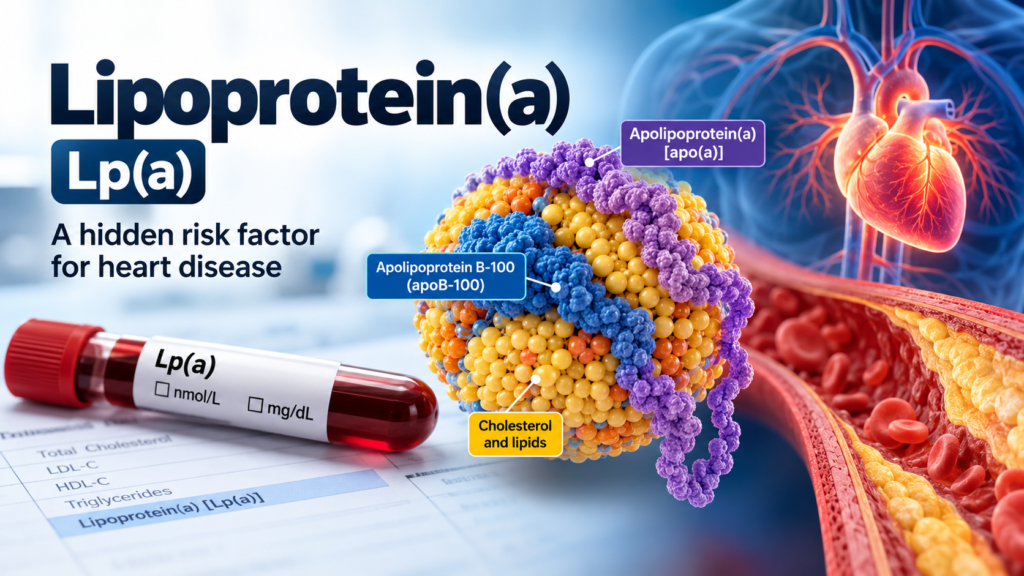
Lipoprotein(a) is an LDL-like lipoprotein particle consisting of two main components:
- Apolipoprotein B-100 (apoB-100): The structural protein associated with the LDL-like particle.
- Apolipoprotein(a) [apo(a)]: A distinctive protein attached to apoB-100 that differentiates Lp(a) from ordinary LDL.
Lp(a) transports cholesterol and oxidized phospholipids in the bloodstream. These components can contribute to atherosclerosis, inflammation, and vascular injury.
Lp(a) is different from LDL cholesterol, HDL cholesterol, and triglyceride-rich lipoproteins. A standard lipid profile does not directly measure Lp(a), so a separate blood test is required.
2. Why Is Elevated Lp(a) Dangerous?
High Lp(a) contributes to cardiovascular disease through several mechanisms.
Atherosclerosis
Lp(a) carries cholesterol into arterial walls, contributing to plaque formation and progression of atherosclerotic cardiovascular disease (ASCVD).
Vascular inflammation
Lp(a) carries oxidized phospholipids that can promote inflammatory processes within blood vessels and atherosclerotic plaques.
Thrombosis-related effects
The apo(a) component resembles plasminogen structurally. It may interfere with aspects of fibrinolysis, although the clinical importance of this mechanism remains incompletely established.
Calcific aortic valve stenosis
Elevated Lp(a) is a recognized risk factor for calcification and narrowing of the aortic valve. Severe aortic stenosis can cause exertional breathlessness, chest pain, syncope, and heart failure.
Importantly, elevated Lp(a) increases cardiovascular risk independently of LDL cholesterol and can add to the risk from hypertension, diabetes, smoking, chronic kidney disease, and other lipid abnormalities.
3. What Causes High Lp(a)?
The primary determinant of Lp(a) concentration is genetic variation in the LPA gene.
Important characteristics include:
- Lp(a) levels are largely inherited.
- Levels are usually established early in life and remain relatively stable.
- Diet, physical activity, and weight loss generally have little effect on Lp(a) concentration.
- Levels vary among individuals and populations, partly because of genetic differences.
- Certain conditions, including kidney disease, hypothyroidism, and some inflammatory or physiological states, may influence measured levels.
Because elevated Lp(a) is inherited, first-degree relatives—parents, siblings, and children—of individuals with high Lp(a) may also benefit from testing.
4. Who Should Have Lp(a) Testing?
The 2026 ACC/AHA multisociety dyslipidemia guideline recommends measuring Lp(a) at least once in all adults.
Testing is particularly important in people with:
- Premature coronary artery disease or ischemic stroke.
- A family history of premature ASCVD.
- Familial hypercholesterolemia.
- Recurrent cardiovascular events despite appropriate LDL-lowering therapy.
- Elevated cardiovascular risk that appears disproportionate to conventional risk factors.
- A family history of elevated Lp(a) or premature calcific aortic valve stenosis.
Testing children or adolescents may be appropriate when there is familial hypercholesterolemia, markedly elevated parental Lp(a), or a strong family history of premature cardiovascular disease.
How is Lp(a) measured?
Lp(a) is measured using a blood test. Fasting is generally not necessary.
The result is reported in either:
- mg/dL: Mass concentration.
- nmol/L: Molar particle concentration.
When available, an assay reported in nmol/L and relatively insensitive to apo(a) isoform size is preferred.
Important: Do not convert mg/dL to nmol/L using a universal conversion factor. The relationship varies with particle characteristics and assay methodology.
5. What Is a Normal Lp(a) Level?
The 2026 ACC/AHA guideline identifies Lp(a) concentrations of at least 125 nmol/L (50 mg/dL) as a cardiovascular risk-enhancing factor.
The following categories are useful for clinical interpretation:
| Lp(a), nmol/L | Lp(a), mg/dL | Interpretation |
|---|---|---|
| Less than 75 | Less than 30 | Lower-risk category |
| 75 to less than 125 | 30 to less than 50 | Intermediate category |
| 125 or higher | 50 or higher | High; risk-enhancing |
These categories are approximate clinical thresholds, not absolute boundaries between safe and dangerous levels. Cardiovascular risk generally increases continuously as Lp(a) rises.
The 2026 guideline also notes that levels of at least 250 nmol/L (100 mg/dL) are associated with approximately twice the estimated ASCVD risk compared with low levels, while levels around 430 nmol/L (180 mg/dL) may be associated with roughly fourfold higher risk in population-based estimates.
These are relative-risk estimates, not an individual’s absolute probability of having a heart attack. Absolute risk also depends on age, blood pressure, smoking, diabetes, LDL cholesterol, and other clinical factors.
6. How Is High Lp(a) Treated?
The main objective is to reduce overall cardiovascular risk. Although specific Lp(a)-lowering therapies are being developed, established treatment currently focuses on intensive management of modifiable risk factors and appropriate lowering of LDL cholesterol.
6.1 Lower LDL cholesterol
For people with elevated Lp(a), clinicians should assess the patient’s overall cardiovascular risk and consider earlier or more intensive LDL-C lowering.
Treatment options include:
Statins: Atorvastatin and rosuvastatin are commonly used to lower LDL cholesterol and reduce cardiovascular events. Statins do not meaningfully lower Lp(a) and may cause a small increase in some individuals. However, their cardiovascular benefits remain important, and an elevated Lp(a) level is not a reason to discontinue an indicated statin.
Ezetimibe: This medication can be added when additional LDL-C lowering is needed.
PCSK9 monoclonal antibodies: Evolocumab and alirocumab substantially reduce LDL cholesterol and may lower Lp(a) by approximately 15–30%. In appropriate high-risk patients, particularly those with established ASCVD who remain above treatment goals, they can provide additional cardiovascular protection.
Bempedoic acid: This is another option for selected patients who require additional LDL-C lowering, including some people who cannot tolerate recommended statin regimens.
Medication selection and LDL-C targets should be individualized according to established ASCVD, overall risk, comorbidities, treatment tolerance, and current guideline recommendations.
6.2 Control other cardiovascular risk factors
People with elevated Lp(a) should receive comprehensive preventive care, including:
- Maintaining blood pressure within an appropriate target.
- Achieving good glycemic control in diabetes.
- Avoiding tobacco and nicotine exposure.
- Following a heart-healthy dietary pattern.
- Exercising regularly and maintaining a healthy weight.
- Managing chronic kidney disease and other relevant conditions.
- Adhering to prescribed lipid-lowering medication.
These measures may not substantially lower Lp(a) itself, but they can meaningfully reduce overall cardiovascular risk.
6.3 Is aspirin recommended for high Lp(a)?
Not routinely on the basis of elevated Lp(a) alone.
Some observational studies and subgroup analyses suggest that aspirin may benefit selected individuals with elevated Lp(a), but evidence is insufficient to recommend aspirin universally for primary prevention solely because Lp(a) is high.
The decision should consider established cardiovascular disease, overall risk, age, and bleeding risk.
6.4 Is lipoprotein apheresis an option?
Lipoprotein apheresis is a specialized procedure that removes circulating atherogenic lipoproteins, including Lp(a). It may be considered in selected patients with very high Lp(a) and progressive cardiovascular disease despite optimal medical treatment.
Eligibility, regulatory approval, and availability vary by country. It is not a routine treatment for most people with elevated Lp(a).
6.5 Are there medications that specifically lower Lp(a)?
Several investigational therapies target Lp(a) production, including antisense oligonucleotides and small-interfering RNA (siRNA) therapies.
These treatments have demonstrated substantial reductions in Lp(a) in clinical studies. However, lowering a biomarker is not the same as proving that treatment prevents heart attacks, strokes, or cardiovascular death.
Their role in routine care depends on completed cardiovascular outcome trials, regulatory approval, and updated clinical guidelines. Clinicians should check current local approvals and evidence before considering any emerging treatment.
Niacin can lower Lp(a) to some extent, but it is not routinely recommended solely for this purpose because clinical outcome benefits have not been established and adverse effects can occur.
7. Should Family Members Be Tested?
Yes, particularly first-degree relatives of someone with markedly elevated Lp(a), premature ASCVD, or familial hypercholesterolemia.
Because Lp(a) is largely inherited, family testing can identify people who may benefit from earlier cardiovascular risk assessment and preventive treatment.
A single measurement is generally sufficient for most adults, although repeat testing may be appropriate when the initial result is borderline or when significant clinical circumstances could alter the concentration, such as certain kidney, thyroid, or physiological conditions.
8. Clinical Approach to an Elevated Lp(a) Result
A practical approach is:
- Confirm the result and units. Review the assay, reported units, and clinical context.
- Assess global ASCVD risk. Consider age, blood pressure, diabetes, smoking, kidney disease, family history, and prior cardiovascular events.
- Evaluate the full lipid profile. Review LDL-C, non-HDL-C, triglycerides, and, when useful, apoB.
- Optimize LDL-C lowering. Use appropriate guideline-based lipid-lowering therapy and intensify treatment when indicated.
- Manage other risk factors. Address blood pressure, glucose, smoking, diet, physical activity, and medication adherence.
- Consider family screening. Offer Lp(a) measurement to first-degree relatives where appropriate.
- Refer selected patients. Specialist assessment may be useful for very high Lp(a), premature or recurrent ASCVD, familial hypercholesterolemia, or difficult-to-control lipid disorders.
For patients with established ASCVD and elevated Lp(a), the 2026 guideline recommends adding a PCSK9 monoclonal antibody with proven cardiovascular benefit when LDL-C and non-HDL-C goals have not been achieved on maximally tolerated statin therapy.
Conclusion
Lipoprotein(a) is an important, largely inherited cardiovascular risk factor that is not detected by a routine lipid profile. The 2026 ACC/AHA multisociety dyslipidemia guideline recommends measuring Lp(a) at least once in every adult.
An Lp(a) level of at least 125 nmol/L (50 mg/dL) is considered a risk-enhancing factor, with higher levels associated with greater cardiovascular risk.
Although currently established treatments do not specifically eliminate elevated Lp(a), intensive LDL-C lowering and comprehensive management of cardiovascular risk factors can help reduce overall risk. Identifying affected individuals and their relatives early is an important step toward preventing cardiovascular disease.
Medical disclaimer: This article is for educational purposes and does not replace individualized medical evaluation or treatment. Medication decisions should be based on a patient’s clinical history, cardiovascular risk, and current local guidelines.
Frequently Asked Questions (FAQ)
1. What is the main difference between Lp(a) and LDL cholesterol?
LDL cholesterol is a major contributor to atherosclerosis, while Lp(a) is an LDL-like particle containing an additional protein called apolipoprotein(a). Elevated Lp(a) carries additional cardiovascular risk, even when LDL-C is within the recommended range.
2. What is considered a high Lp(a) level?
An Lp(a) level of at least 125 nmol/L or 50 mg/dL is considered high and is a cardiovascular risk-enhancing factor. Levels of 250 nmol/L or 100 mg/dL and above are associated with substantially greater estimated risk.
3. Should everyone have an Lp(a) test?
The 2026 ACC/AHA multisociety guideline recommends measuring Lp(a) at least once in all adults. Testing is especially important for individuals with premature cardiovascular disease, familial hypercholesterolemia, or a family history of premature ASCVD.
4. Does a high Lp(a) level mean that a heart attack will occur?
No. Elevated Lp(a) increases risk but does not mean a cardiovascular event is inevitable. Absolute risk depends on other factors, including age, blood pressure, diabetes, smoking, LDL-C, and previous cardiovascular disease.
5. Can diet and exercise lower Lp(a)?
Diet and exercise usually have little effect on Lp(a) concentration because it is predominantly genetically determined. However, a healthy lifestyle helps reduce overall cardiovascular risk and remains essential.
6. Do statins lower Lp(a)?
Statins primarily lower LDL-C and reduce cardiovascular events. They generally do not lower Lp(a) and may modestly increase it in some individuals. Statins should not be stopped solely because Lp(a) is elevated.
7. Which medications lower Lp(a)?
PCSK9 monoclonal antibodies lower LDL-C substantially and typically reduce Lp(a) by approximately 15–30%. They may be appropriate for selected high-risk patients. Investigational RNA-targeted therapies have produced larger reductions, but clinical outcome evidence and regulatory status must be assessed before routine use.
8. Should family members be screened?
Yes. First-degree relatives of individuals with elevated Lp(a), particularly those with premature ASCVD or familial hypercholesterolemia, should be considered for testing because high Lp(a) is inherited.
9. Does a routine lipid profile include Lp(a)?
No. A standard lipid profile measures cholesterol and triglycerides but does not directly measure Lp(a). A separate blood test is required.
10. Does Lp(a) need to be measured every year?
Usually not. One measurement is generally sufficient because Lp(a) is relatively stable throughout life. Repeat testing may be appropriate when the original result is borderline, when a relevant clinical condition changes, or when the clinician needs to clarify an unexpected result.
References
1. Blumenthal RS, Morris PB, Gaudino M, et al. 2026 ACC/AHA/AACVPR/ABC/ACPM/ADA/AGS/APhA/ASPC/NLA/PCNA Guideline on the Management of Dyslipidemia. Circulation. Published online March 13, 2026. doi:10.1161/CIR.0000000000001423.
2. Bajaj A, Ballantyne CM, Soffer DE, et al. A focused update to the 2019 NLA scientific statement on use of lipoprotein(a) in clinical practice. National Lipid Association, 2024. NLA clinical guidance.
3. Tsimikas S. A test in context: Lipoprotein(a): diagnosis, prognosis, controversies, and emerging therapies. Journal of the American College of Cardiology. 2017;69(6):692–711. doi:10.1016/j.jacc.2016.11.042.
4. Kronenberg F, Mora S, Stroes ESG, et al. Lipoprotein(a) in atherosclerotic cardiovascular disease and aortic stenosis: a European Atherosclerosis Society consensus statement. European Heart Journal. 2022;43(39):3925–3946. doi:10.1093/eurheartj/ehac361.
5. Reyes-Soffer G, Ginsberg HN, Berglund L, et al. Lipoprotein(a): a genetically determined, causal, and prevalent risk factor for atherosclerotic cardiovascular disease. Arteriosclerosis, Thrombosis, and Vascular Biology. 2022;42(2):e48–e60. doi:10.1161/ATV.0000000000000147.
6. American Heart Association. 2026 Guideline on the Management of Dyslipidemia: Top Things to Know. Official guideline summary.