
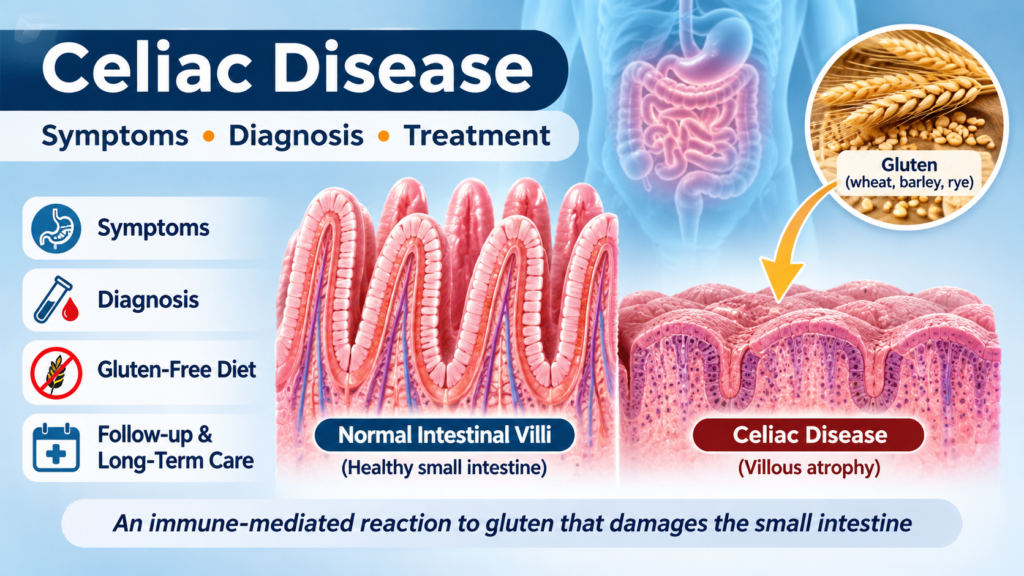
Celiac disease (Coeliac disease) is a chronic immune-mediated disorder triggered by the ingestion of gluten in genetically susceptible individuals. It primarily affects the small intestine, causing inflammation and damage to the intestinal villi, which can lead to impaired nutrient absorption, gastrointestinal symptoms, nutritional deficiencies, and several extraintestinal complications.
Although celiac disease is commonly associated with chronic diarrhea and weight loss, many patients present with nonspecific symptoms, including iron-deficiency anemia, abdominal bloating, fatigue, osteoporosis, elevated liver enzymes, and neurological manifestations.
Early diagnosis and lifelong adherence to a strict gluten-free diet are essential to restore intestinal health, prevent complications, and improve quality of life.
1. What is celiac disease?
Celiac disease is an autoimmune-mediated enteropathy caused by an abnormal immune response to gluten, a group of storage proteins found in wheat, barley, and rye.
When a person with celiac disease consumes gluten:
-
Gluten-derived peptides reach the small intestinal mucosa.
-
Tissue transglutaminase (tTG) modifies gluten peptides through deamidation.
-
Deamidated peptides bind to HLA-DQ2 or HLA-DQ8 molecules.
-
This activates gluten-specific CD4+ T lymphocytes.
-
An inflammatory immune response develops, damaging the intestinal mucosa.
The characteristic pathological findings include:
-
Villous atrophy.
-
Crypt hyperplasia.
-
Increased intraepithelial lymphocytes.
These changes reduce the absorptive surface area of the small intestine, resulting in malabsorption of nutrients.
2. Causes and risk factors
Celiac disease develops through an interaction between genetic susceptibility, gluten exposure, and immune dysregulation.
A. Genetic factors
Most patients carry one or both of the following HLA genotypes:
-
HLA-DQ2 (approximately 90–95% of patients).
-
HLA-DQ8 (most of the remaining patients).
However, carrying HLA-DQ2 or HLA-DQ8 does not mean that a person will necessarily develop celiac disease. These genes are common in the general population, while celiac disease is much less common.
B. Environmental factors
Gluten exposure is necessary for the development of celiac disease in genetically susceptible individuals.
Other environmental and biological factors may influence disease development, but their precise contributions remain under investigation.
C. Associated conditions
Celiac disease is more common in individuals with:
-
Type 1 diabetes mellitus.
-
Autoimmune thyroid disease.
-
Selective IgA deficiency.
-
Down syndrome.
-
Turner syndrome.
-
First-degree relatives with celiac disease.
3. Clinical manifestations
Celiac disease can present at any age, from early childhood to adulthood. Clinical manifestations vary considerably between patients.
A. Gastrointestinal symptoms
Common gastrointestinal manifestations include:
-
Chronic diarrhea.
-
Abdominal bloating and distension.
-
Excessive flatulence.
-
Recurrent abdominal pain.
-
Weight loss.
-
Steatorrhea (fatty stools).
-
Nausea and vomiting.
-
Chronic constipation.
Some patients have minimal gastrointestinal symptoms or no obvious digestive complaints.
B. Extraintestinal manifestations
Extraintestinal presentations are particularly important because they may be the first indication of celiac disease.
| System | Clinical manifestations |
|---|---|
| Hematological | Iron-deficiency anemia, folate deficiency, vitamin B12 deficiency |
| Bone and mineral | Osteopenia, osteoporosis, osteomalacia, vitamin D deficiency |
| Neurological | Peripheral neuropathy, ataxia, headache |
| Dermatological | Dermatitis herpetiformis |
| Hepatic | Unexplained elevation of aminotransferases |
| Reproductive | Infertility, recurrent miscarriage, menstrual disturbances |
| General | Fatigue, weight loss, weakness |
C. Silent and atypical celiac disease
Some patients have positive celiac serology and characteristic intestinal abnormalities without typical gastrointestinal symptoms.
These patients may be identified during screening for associated autoimmune conditions, unexplained anemia, osteoporosis, or a family history of celiac disease.
Clinical pearl: Consider celiac disease in patients with unexplained iron-deficiency anemia, persistent abdominal bloating, chronic diarrhea, osteoporosis, or unexplained elevation of liver enzymes, even when gastrointestinal symptoms are absent.
4. Diagnosis of celiac disease
Early and accurate diagnosis is important because patients who start a gluten-free diet before completing diagnostic investigations may have false-negative serological and histological results.
Important: Patients should continue eating a gluten-containing diet until diagnostic testing is completed, unless there is a medical reason to do otherwise.
A. Initial serological testing
The recommended first-line blood tests are:
| Test | Clinical significance |
|---|---|
| IgA anti-tissue transglutaminase (tTG-IgA) | Preferred initial screening test |
| Total serum IgA | Detects IgA deficiency that may cause false-negative tTG-IgA |
| IgG anti-tTG | Alternative in IgA deficiency |
| IgG deamidated gliadin peptide (DGP-IgG) | Alternative in IgA deficiency |
| IgA anti-endomysial antibody (EMA-IgA) | Useful in selected diagnostic situations |
Interpretation:
-
Positive tTG-IgA: Strongly suggests celiac disease and requires further diagnostic assessment.
-
Negative tTG-IgA with normal total IgA: Makes celiac disease less likely but does not completely exclude it when clinical suspicion is high.
-
Negative tTG-IgA with IgA deficiency: Requires IgG-based testing.
-
Very high tTG-IgA: May qualify selected patients for a specialist-supervised no-biopsy diagnostic pathway.
Routine antigliadin antibody testing is not recommended because of its lower diagnostic accuracy.
B. Upper gastrointestinal endoscopy with duodenal biopsy
For most adults, upper gastrointestinal endoscopy with duodenal biopsies remains an important method of confirming the diagnosis.
The 2025 European Society for the Study of Coeliac Disease (ESsCD) guidelines recommend:
-
At least four biopsies from the distal duodenum (second part).
-
Two additional biopsies from the duodenal bulb.
Histopathological findings include:
-
Increased intraepithelial lymphocytes.
-
Crypt hyperplasia.
-
Partial or total villous atrophy.
The modified Marsh classification is commonly used to describe intestinal histological changes.
| Marsh classification | Histological findings |
|---|---|
| Marsh 0 | Normal mucosa |
| Marsh I | Increased intraepithelial lymphocytes |
| Marsh II | Increased lymphocytes with crypt hyperplasia |
| Marsh III | Villous atrophy with crypt hyperplasia and increased lymphocytes |
C. Can celiac disease be diagnosed without intestinal biopsy?
Yes, in selected patients.
The 2025 ESsCD guidelines introduce a conditional no-biopsy approach for selected adults:
-
Age below 45 years.
-
IgA anti-TG2 (tTG-IgA) at least 10 times the upper limit of normal.
-
Confirmation of positive serology in a second blood sample.
-
Appropriate specialist assessment and shared decision-making.
This approach should not automatically be applied to every patient with positive serology. Clinical context, assay performance, and local guideline recommendations must be considered.
PubMed+1
D. Role of HLA-DQ2 and HLA-DQ8 testing
HLA testing is not recommended as a routine initial diagnostic test.
However, it can be useful when:
-
Serology and biopsy results are inconsistent.
-
The patient has already started a gluten-free diet.
-
There is diagnostic uncertainty.
-
Celiac disease needs to be excluded in selected cases.
A negative HLA-DQ2/DQ8 result makes celiac disease extremely unlikely, whereas a positive result does not confirm the diagnosis.
E. What if the patient has already stopped eating gluten?
A gluten challenge may be required before repeating serology or intestinal biopsy.
The 2025 ESsCD guidelines suggest a minimum of approximately 3 g of gluten daily for 6 weeks, with higher intake or longer duration potentially improving diagnostic accuracy when tolerated.
The 2026 BSG guideline recommends 3–6 g daily for at least 6 weeks.
This should be planned with a gastroenterologist, particularly in patients with significant symptoms.
PubMed Central (PMC)+1
5. Screening: Who should be tested?
Routine population-wide screening is not generally recommended. However, targeted testing should be considered in individuals with increased risk.
Patients who should be considered for screening include:
-
First-degree relatives of patients with celiac disease.
-
Patients with type 1 diabetes mellitus.
-
Patients with autoimmune thyroid disease.
-
Patients with unexplained iron-deficiency anemia.
-
Patients with unexplained osteoporosis or osteopenia.
-
Patients with chronic diarrhea or persistent abdominal bloating.
-
Patients with unexplained elevation of liver enzymes.
-
Patients with dermatitis herpetiformis.
-
Patients with unexplained peripheral neuropathy or ataxia.
-
Patients with selective IgA deficiency.
Testing should ideally be performed while the patient is consuming gluten.
NICE+1
6. Treatment of celiac disease
A strict, lifelong gluten-free diet is currently the only established standard treatment for celiac disease.
The primary objectives of treatment are:
-
Resolution of gastrointestinal symptoms.
-
Healing of intestinal mucosa.
-
Correction of nutritional deficiencies.
-
Prevention of complications.
-
Improvement in quality of life.
A. Gluten-free diet
Patients must completely avoid foods containing wheat, barley, and rye.
Foods to avoid
| Food category | Examples |
|---|---|
| Wheat | Bread, noodles, pasta, wheat flour |
| Barley | Barley soup, malt products |
| Rye | Rye bread and rye flour |
| Bakery products | Cakes, biscuits, pastries |
| Processed foods | Some sauces, seasonings, soups and processed meats |
Patients should carefully check food labels because gluten may be present in processed foods, sauces, condiments, and food additives.
Cross-contamination during food preparation is another important concern.
Naturally gluten-free foods
| Food group | Suitable choices |
|---|---|
| Grains and starches | Rice, corn, quinoa, millet, potatoes, cassava |
| Protein | Fish, chicken, eggs, meat, legumes |
| Fruits | All fresh fruits |
| Vegetables | All fresh vegetables |
| Dairy | Milk, plain yogurt, cheese if tolerated |
| Nuts and seeds | Almonds, peanuts, sesame, chia seeds |
Oats: Pure, certified gluten-free oats can be included in the diet for most patients. However, some patients may develop intolerance or an immune response to avenin, an oat protein. Oats should be introduced with appropriate monitoring.
PMC
B. Nutritional supplementation
Many patients have nutritional deficiencies at diagnosis because of intestinal malabsorption.
Common deficiencies include:
-
Iron.
-
Folate.
-
Vitamin B12.
-
Vitamin D.
-
Calcium.
-
Zinc (particularly in patients with severe malabsorption).
Supplementation should be based on laboratory findings and clinical assessment rather than routinely prescribing all vitamins and minerals.
For example:
| Deficiency | Management |
|---|---|
| Iron deficiency | Oral or intravenous iron, depending on severity and absorption |
| Folate deficiency | Folic acid supplementation |
| Vitamin B12 deficiency | Oral or intramuscular vitamin B12 |
| Vitamin D deficiency | Vitamin D replacement |
| Calcium deficiency | Dietary calcium optimization and supplementation when indicated |
| Zinc deficiency | Zinc replacement when confirmed |
C. Role of a specialist dietitian
Referral to a dietitian experienced in celiac disease is strongly recommended.
Dietary education should include:
-
Understanding gluten-free food labels.
-
Avoiding cross-contamination.
-
Planning balanced meals.
-
Maintaining adequate fiber intake.
-
Preventing nutritional deficiencies.
-
Managing eating outside the home and traveling.
A gluten-free diet should be nutritionally balanced rather than relying heavily on commercially manufactured gluten-free products, which may contain high amounts of sugar, fat, or salt.
D. Management of associated conditions
Management should also address complications and associated autoimmune diseases.
Examples include:
-
Iron-deficiency anemia.
-
Osteoporosis and osteomalacia.
-
Vitamin deficiencies.
-
Autoimmune thyroid disease.
-
Type 1 diabetes mellitus.
-
Dermatitis herpetiformis.
Patients with dermatitis herpetiformis may require dermatological assessment and treatment, including dapsone in selected cases, in addition to a gluten-free diet.
7. Follow-up and monitoring
Long-term follow-up is important even when patients experience significant symptomatic improvement.
The 2025 ESsCD guidelines emphasize individualized follow-up, nutritional assessment, dietary adherence, and evaluation of persistent symptoms. The 2026 BSG guideline also recommends regular follow-up after diagnosis.
Wiley Online Library+1
Recommended follow-up schedule
| Timing | Clinical assessment |
|---|---|
| At diagnosis | Symptoms, BMI, CBC, iron, folate, B12, vitamin D, calcium, liver enzymes, thyroid function and nutritional status |
| 4–6 months | Symptoms, dietary adherence, nutritional deficiencies and treatment response |
| 12 months | Clinical review, celiac serology and repeat abnormal laboratory tests |
| 24 months | Dietary review, symptoms, serology when appropriate and assessment of complications |
| Thereafter | Individualized follow-up, often every 1–2 years |
Laboratory monitoring
Consider the following investigations:
-
Complete blood count.
-
Ferritin and iron studies.
-
Folate and vitamin B12.
-
Vitamin D.
-
Calcium and phosphate.
-
Liver function tests.
-
Thyroid function tests.
-
Albumin and other nutritional markers when indicated.
-
Celiac serology (tTG-IgA, interpreted alongside total IgA).
Bone health assessment
Celiac disease can cause reduced bone mineral density due to calcium and vitamin D malabsorption.
Bone mineral density assessment using dual-energy X-ray absorptiometry (DXA) should be considered according to age, risk factors, nutritional status, and disease severity.
The 2026 BSG adult guideline recommends a DXA scan approximately one year after starting a gluten-free diet in newly diagnosed adults, with repeat testing in selected patients with persistent villous atrophy or refractory disease.
DOI
Should repeat intestinal biopsy be performed?
Not every patient requires routine repeat endoscopy.
However, repeat duodenal biopsy should be considered when:
-
Symptoms persist despite a gluten-free diet.
-
Nutritional deficiencies fail to improve.
-
Serology remains persistently elevated.
-
There is concern about ongoing intestinal inflammation.
-
Refractory celiac disease is suspected.
Importantly, normalization of tTG-IgA does not necessarily prove complete intestinal mucosal healing.
8. Complications of celiac disease
Untreated or poorly controlled celiac disease can result in several complications.
A. Nutritional complications
-
Iron-deficiency anemia.
-
Folate and vitamin B12 deficiency.
-
Vitamin D deficiency.
-
Osteopenia and osteoporosis.
-
Osteomalacia.
-
Protein-calorie malnutrition.
B. Reproductive complications
-
Infertility.
-
Recurrent miscarriage.
-
Adverse pregnancy outcomes in some patients.
-
Delayed puberty in children.
C. Neurological complications
-
Peripheral neuropathy.
-
Gluten-related ataxia.
-
Headaches.
-
Cognitive complaints.
D. Malignancy
Although the absolute risk is low, celiac disease is associated with an increased risk of certain malignancies, particularly:
-
Enteropathy-associated T-cell lymphoma (EATL).
-
Small intestinal adenocarcinoma.
Persistent symptoms, unexplained weight loss, abdominal pain, or worsening nutritional status despite strict dietary adherence require further investigation.
9. Non-responsive and refractory celiac disease
A. Non-responsive celiac disease
Non-responsive celiac disease refers to persistent symptoms, laboratory abnormalities, or other evidence of disease activity despite treatment with a gluten-free diet.
Before diagnosing refractory celiac disease, clinicians should investigate:
-
Unintentional gluten exposure.
-
Poor dietary adherence.
-
Incorrect initial diagnosis.
-
Lactose intolerance.
-
Small intestinal bacterial overgrowth (SIBO).
-
Microscopic colitis.
-
Irritable bowel syndrome.
-
Exocrine pancreatic insufficiency.
-
Other gastrointestinal disorders.
A careful dietary review by an experienced dietitian is an important first step.
B. Refractory celiac disease
Refractory celiac disease (RCD) is a rare but serious condition characterized by persistent or recurrent malabsorptive symptoms and villous atrophy despite a strict gluten-free diet, after excluding ongoing gluten exposure and alternative diagnoses.
It is classified into two major types:
| Type | Characteristics |
|---|---|
| Type I | Intraepithelial lymphocytes have a relatively normal phenotype |
| Type II | Aberrant or clonal intraepithelial lymphocytes, associated with a higher risk of EATL |
Management requires specialist gastroenterology assessment, including histological review and immunophenotyping.
Treatment may involve corticosteroids, immunosuppressive agents, nutritional support, and specialist-directed therapies. Selected refractory cases may require advanced treatments in tertiary centers.
The 2025 ESsCD management guideline provides updated recommendations for refractory disease, including emerging targeted therapeutic approaches.
PMC
10. Celiac disease in children
Celiac disease can develop after gluten is introduced into the diet.
Common pediatric manifestations include:
-
Chronic diarrhea.
-
Abdominal distension.
-
Poor weight gain.
-
Failure to thrive.
-
Short stature.
-
Delayed puberty.
-
Iron-deficiency anemia.
-
Irritability and fatigue.
The 2020 European Society for Paediatric Gastroenterology, Hepatology and Nutrition (ESPGHAN) guidelines recommend:
-
Initial testing with total IgA and tTG-IgA.
-
IgG-based testing in children with IgA deficiency.
-
Duodenal biopsy when tTG-IgA is positive but below 10 times the upper limit of normal.
-
A no-biopsy diagnosis when tTG-IgA is at least 10 times the upper limit of normal and EMA-IgA is positive in a second blood sample, under specialist supervision.
Children should be managed by a pediatric gastroenterologist or clinician experienced in celiac disease.
PubMed+1
11. Prevention of celiac disease
Currently, there is no proven method to prevent celiac disease in genetically susceptible individuals.
However, early recognition, accurate diagnosis, and lifelong adherence to a gluten-free diet can prevent ongoing intestinal injury and reduce the risk of complications.
First-degree relatives of patients should be informed about the possibility of developing celiac disease and undergo testing when clinically indicated.
12. Frequently Asked Questions (FAQ)
1. Is celiac disease an autoimmune disease?
Yes. Celiac disease is an immune-mediated autoimmune disorder in which gluten triggers an abnormal immune response, causing inflammation and damage to the small intestinal mucosa.
2. What foods should patients with celiac disease avoid?
Patients should avoid wheat, barley, rye, and products containing these grains. They should also check processed foods for hidden gluten and prevent cross-contamination.
3. Can patients with celiac disease eat rice?
Yes. Rice is naturally gluten-free and is generally safe for patients with celiac disease, provided it has not been contaminated during processing or preparation.
4. Can patients with celiac disease eat oats?
Yes, most patients can consume pure, certified gluten-free oats. However, a small proportion may develop an immune response or intolerance to oat proteins.
5. Is celiac disease the same as gluten intolerance?
No. Celiac disease is an autoimmune-mediated intestinal disorder. Non-celiac gluten sensitivity causes symptoms related to gluten-containing foods without the characteristic autoimmune response and intestinal damage of celiac disease.
Wheat allergy is another distinct condition involving an allergic immune response to wheat proteins.
6. Can celiac disease develop in adults?
Yes. Celiac disease can develop or be diagnosed at any age, including in older adults. Some patients remain undiagnosed for many years because their symptoms are nonspecific.
7. Can celiac disease cause anemia?
Yes. Iron deficiency is particularly common because damage to the proximal small intestine reduces iron absorption. Folate and vitamin B12 deficiencies may also occur.
8. Can celiac disease cause osteoporosis?
Yes. Intestinal malabsorption of calcium and vitamin D can contribute to reduced bone mineral density, osteopenia, osteoporosis, and osteomalacia.
9. Is celiac disease curable?
There is currently no established cure. However, most patients can achieve significant symptomatic improvement and intestinal healing through lifelong adherence to a strict gluten-free diet.
10. How long does it take for the intestine to heal?
Symptoms may improve within weeks to months after starting a gluten-free diet. However, complete intestinal mucosal healing may take considerably longer, sometimes several years, particularly in adults.
11. Do patients need to follow a gluten-free diet for life?
Yes. Celiac disease is a lifelong condition. Even when symptoms disappear, continued gluten exposure can cause intestinal inflammation and damage.
12. Can celiac disease cause elevated liver enzymes?
Yes. Some patients develop unexplained elevation of ALT and AST, sometimes referred to as celiac hepatitis. Liver enzymes often improve after adherence to a gluten-free diet. Persistent abnormalities require evaluation for other liver diseases.
13. Should family members be tested?
First-degree relatives, including parents, siblings, and children, have an increased risk of celiac disease. Serological screening should be considered, particularly when symptoms or associated risk factors are present.
14. Can patients with celiac disease travel and eat outside their homes?
Yes. Patients can travel and maintain a healthy lifestyle by planning meals, checking food ingredients, informing restaurants about their dietary requirements, and avoiding cross-contamination.
15. Can celiac disease cause neurological symptoms?
Yes. Neurological manifestations can include peripheral neuropathy, gluten-related ataxia, headaches, and other neurological complaints.
13. Key clinical takeaways
-
Celiac disease is a lifelong immune-mediated disorder triggered by gluten.
-
Clinical presentation is variable and may be gastrointestinal or extraintestinal.
-
Consider celiac disease in unexplained iron-deficiency anemia, osteoporosis, chronic diarrhea, and unexplained elevated liver enzymes.
-
Initial screening should include tTG-IgA and total serum IgA.
-
Patients should continue consuming gluten until diagnostic evaluation is completed.
-
Duodenal biopsy remains an important diagnostic method, although selected adults and children may qualify for a no-biopsy pathway.
-
A strict, lifelong gluten-free diet is the cornerstone of treatment.
-
Nutritional deficiencies and bone health require appropriate assessment and follow-up.
-
Persistent symptoms despite a gluten-free diet require evaluation for gluten exposure, alternative diagnoses, and refractory celiac disease.
Conclusion
Celiac disease is an important but frequently underdiagnosed cause of chronic gastrointestinal symptoms, nutritional deficiencies, and extraintestinal manifestations. Accurate diagnosis requires appropriate serological testing and, in most adults, histological assessment of the small intestine.
A strict lifelong gluten-free diet, supported by nutritional counseling and regular clinical monitoring, remains the cornerstone of management. Early recognition and appropriate treatment can restore intestinal function, correct nutritional deficiencies, and substantially improve patients’ long-term health and quality of life.
References and clinical guidelines
The following references were used to prepare this article, with emphasis on the most recent adult guidelines available in November 2026.
1. Penny HA, et al. (2026). The 2026 British Society of Gastroenterology guidelines on the diagnosis and management of adult coeliac disease. Gut. 2026.
DOI: 10.1136/gutjnl-2025-337747.
2. Al-Toma A, et al. (2026). European Society for the Study of Coeliac Disease (ESsCD) 2025 Updated Guidelines on the Diagnosis and Management of Coeliac Disease in Adults. Part 2: Management, Follow-Up, and Complex Disease Courses. United European Gastroenterology Journal. 2026;14(2):e70195.
DOI: 10.1002/ueg2.70195.
3. European Society for the Study of Coeliac Disease (ESsCD). (2025). Updated Guidelines on the Diagnosis and Management of Coeliac Disease in Adults. Part 1: Diagnostic Approach.
DOI: 10.1002/ueg2.70119.
4. Rubio-Tapia A, et al. (2023). American College of Gastroenterology Guidelines Update: Diagnosis and Management of Celiac Disease. American Journal of Gastroenterology. 2023;118(1):59–76.
DOI: 10.14309/ajg.0000000000002075.
5. Husby S, et al. (2020). European Society Paediatric Gastroenterology, Hepatology and Nutrition Guidelines for Diagnosing Coeliac Disease. Journal of Pediatric Gastroenterology and Nutrition. 2020;70(1):141–156.
DOI: 10.1097/MPG.0000000000002497.
6. National Institute for Health and Care Excellence (NICE). Coeliac disease: recognition, assessment and management. Guideline NG20.
https://www.nice.org.uk/guidance/ng20.
Medical disclaimer: This article is intended for educational purposes and should not replace professional medical evaluation, diagnosis, or individualized treatment.