
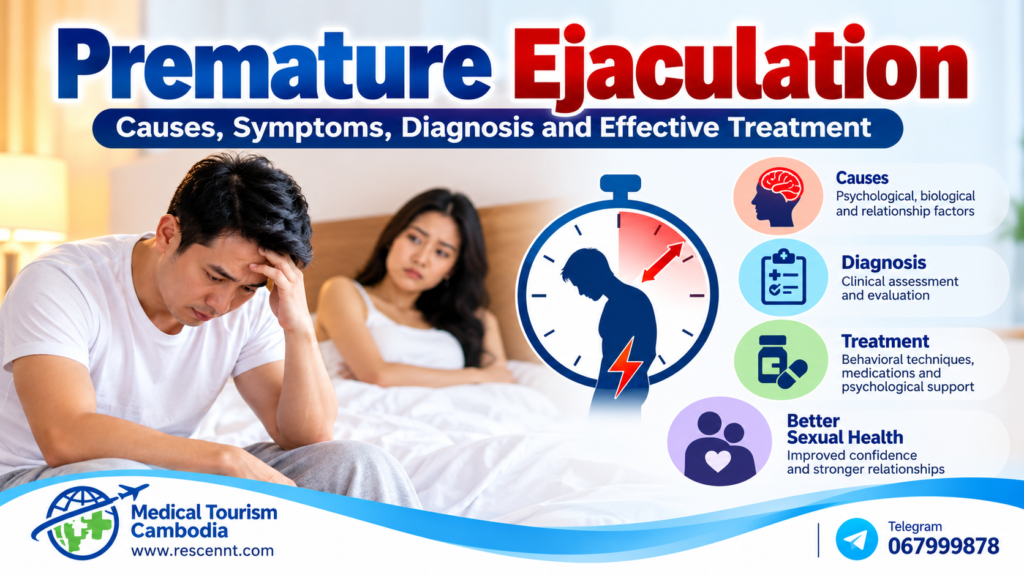
With appropriate assessment, behavioral strategies, psychological support, and medication when indicated, many men can improve ejaculatory control and sexual satisfaction.
This article explains the symptoms, causes, diagnosis, and treatment of premature ejaculation based on established international guidelines and clinical evidence.
What Is Premature Ejaculation?
Premature ejaculation is a male sexual dysfunction characterized by ejaculation that occurs earlier than desired, difficulty delaying ejaculation, and clinically significant distress or interpersonal consequences.
The International Society for Sexual Medicine (ISSM) and the American Urological Association/Sexual Medicine Society of North America (AUA/SMSNA) provide widely used clinical definitions.
Two commonly recognized forms are:
- Lifelong premature ejaculation: Ejaculation occurs from the first sexual experiences, usually before or within approximately one minute of vaginal penetration, with difficulty delaying ejaculation and associated distress.
- Acquired premature ejaculation: A noticeable reduction in ejaculatory latency develops after a period of previously satisfactory sexual function. Ejaculation may occur within approximately three minutes or less, although the change from the individual’s previous experience and the associated symptoms are also important.
These time thresholds are clinical guides, not absolute requirements for diagnosis. Definitions and evidence are primarily based on vaginal intercourse; they may not directly apply to other sexual activities.
Occasional rapid ejaculation is common and does not necessarily indicate a medical disorder.
Symptoms of Premature Ejaculation
Common symptoms include:
- Ejaculation occurring sooner than desired during sexual activity.
- Difficulty delaying ejaculation consistently.
- Feelings of frustration, embarrassment, anxiety, or reduced sexual confidence.
- Avoidance of sexual intimacy or relationship difficulties.
- Reduced satisfaction for the individual or partner.
A diagnosis should consider ejaculation timing, perceived control, persistence, and the degree of distress rather than relying on timing alone.
What Causes Premature Ejaculation?
Premature ejaculation can result from a combination of biological, psychological, behavioral, and relationship factors.
1. Psychological factors
Potential contributors include:
- Performance anxiety.
- Stress and emotional distress.
- Depression or anxiety symptoms.
- Relationship conflict.
- Fear of sexual failure or negative sexual experiences.
Psychological factors can contribute to symptoms, but premature ejaculation should not automatically be considered a purely psychological problem.
2. Biological factors
Possible contributors include:
- Differences in serotonergic neurotransmission involved in ejaculation.
- Genetic susceptibility, particularly in lifelong premature ejaculation.
- Erectile dysfunction, which may lead a man to rush sexual activity out of concern about losing an erection.
- Thyroid dysfunction, particularly hyperthyroidism, in some men with acquired premature ejaculation.
- Prostatitis or chronic pelvic pain symptoms in selected patients.
- Other relevant medical or medication-related factors.
Not every patient has an identifiable underlying cause.
3. Relationship and situational factors
Ejaculation timing may vary according to the partner, sexual situation, frequency of sexual activity, stress, and level of arousal.
Clinicians should distinguish persistent premature ejaculation from occasional rapid ejaculation or unrealistic expectations about how long intercourse should last.
How Is Premature Ejaculation Diagnosed?
Diagnosis is primarily clinical. There is no single blood test that confirms premature ejaculation.
Medical and sexual history
A clinician should assess:
- Whether symptoms have been present since the first sexual experiences or developed later.
- Approximate time from penetration to ejaculation, when applicable.
- Ability to delay ejaculation.
- Frequency and consistency of symptoms.
- Personal distress, relationship effects, and sexual satisfaction.
- Erectile function and libido.
- Urinary symptoms, pelvic pain, thyroid symptoms, and relevant medical history.
- Current medications, alcohol or substance use, and psychological factors.
Validated questionnaires, such as the Premature Ejaculation Diagnostic Tool (PEDT), may help support assessment but should not replace clinical judgment.
Physical examination and investigations
A focused physical examination may be appropriate, particularly for acquired symptoms or suspected underlying disease.
Routine laboratory investigations are generally unnecessary for uncomplicated lifelong premature ejaculation. Testing should be guided by the history and examination. For example, thyroid function tests may be appropriate when hyperthyroidism is suspected, while urinary or prostate investigations may be considered when relevant symptoms are present.
Erectile dysfunction should be assessed because treating it may improve ejaculatory control in some patients.
Evidence-Based Treatment of Premature Ejaculation
Treatment should be individualized according to the type of premature ejaculation, underlying conditions, patient preference, medication availability, and treatment goals.
1. Education and behavioral techniques
Behavioral approaches may help improve awareness of arousal and ejaculatory control.
Start-stop technique: Sexual stimulation is paused when the man feels close to ejaculation. Stimulation resumes after the urge decreases, and the process can be repeated.
Squeeze technique: Stimulation is paused, and gentle pressure is applied around the glans or area where the glans meets the shaft until the urge to ejaculate decreases. The technique should not cause pain.
Pacing and communication: Slowing stimulation, changing positions, taking breaks, and communicating openly with a partner may reduce performance pressure.
These techniques may be useful, especially when combined with other treatments, although evidence for long-term benefit varies.
2. Psychological and sex therapy
Psychosexual counseling or cognitive behavioral approaches can help address performance anxiety, negative expectations, relationship difficulties, and distress associated with premature ejaculation.
Couples-based therapy may be useful when both partners wish to participate.
Psychological support does not imply that symptoms are imaginary; it addresses factors that can influence sexual response and treatment outcomes.
3. Topical anesthetics
Topical lidocaine or lidocaine-prilocaine preparations can reduce penile sensitivity and delay ejaculation.
Important considerations include:
- Follow the specific product instructions regarding amount and application time.
- Remove or wash off the product as directed before sexual contact, or use a compatible condom where appropriate.
- Avoid transfer to the partner, which may cause genital numbness or reduced sexual sensation.
- Discontinue use if significant irritation or an allergic reaction occurs.
These products can be effective, but excessive application may cause undesirable numbness or interfere with sexual pleasure.
4. Selective serotonin reuptake inhibitors (SSRIs)
SSRIs are used to delay ejaculation. Depending on local approval and clinical circumstances, options may include dapoxetine, where available, or off-label daily antidepressants such as paroxetine, sertraline, and fluoxetine.
Dapoxetine is a short-acting SSRI approved for premature ejaculation in some countries. Availability and regulatory approval vary.
Daily SSRIs may be considered when symptoms are persistent and treatment is appropriate. Their effects often begin within several days and may become more apparent over a few weeks.
Potential adverse effects include nausea, fatigue, sweating, gastrointestinal symptoms, reduced libido, erectile difficulties, and delayed or absent orgasm. Dapoxetine may cause dizziness or fainting in some patients.
SSRIs require clinician assessment for contraindications, drug interactions, and relevant psychiatric history. They should not be started, combined, or stopped abruptly without appropriate medical advice, especially when taken regularly.
5. Erectile dysfunction treatment
When premature ejaculation occurs together with erectile dysfunction, clinicians should assess and treat both conditions.
Phosphodiesterase type 5 inhibitors, such as sildenafil or tadalafil, are established treatments for erectile dysfunction. Their role in premature ejaculation without erectile dysfunction is less certain, and they are not universally recommended as first-line treatment for isolated premature ejaculation.
These medicines are contraindicated with nitrate medications and require assessment of cardiovascular status and other potential interactions.
6. Treatment of underlying conditions
When acquired premature ejaculation is associated with an identifiable medical problem, management should address that problem.
Examples include treating confirmed hyperthyroidism or evaluating and managing erectile dysfunction. Prostatitis should be treated when clinically diagnosed, rather than prescribing antibiotics solely because premature ejaculation is present.
7. Other treatments
Tramadol may delay ejaculation in some men, but it is generally reserved for selected cases when safer, established treatments have been ineffective or unsuitable. Risks include dependence, sedation, respiratory depression, and serotonin syndrome when combined with serotonergic medicines.
Evidence for supplements, herbal products, acupuncture, and many invasive procedures is limited or inconsistent. Penile nerve surgery and other irreversible interventions are not routine treatments for premature ejaculation.
Which Treatment Is Best?
There is no single treatment that is best for every patient.
- Lifelong premature ejaculation: Education, behavioral strategies, topical anesthetics, and an appropriate SSRI are potential options.
- Acquired premature ejaculation: Assess for erectile dysfunction, thyroid disease, relevant pelvic or urinary symptoms, medication effects, and psychological factors before selecting treatment.
- Premature ejaculation with erectile dysfunction: Treat the erectile dysfunction and address ejaculation symptoms together.
- Persistent symptoms with anxiety or relationship distress: Consider combining medical treatment with psychosexual counseling.
Combination treatment may be more effective for some patients than either behavioral or medication treatment alone. Treatment should be reviewed according to benefit, adverse effects, and patient preference.
When Should You See a Doctor?
Seek medical assessment if premature ejaculation is persistent, causes significant distress, affects relationships, or develops suddenly after a period of normal sexual function.
Medical evaluation is particularly important when symptoms occur alongside erectile dysfunction, painful ejaculation, pelvic pain, urinary symptoms, blood in the semen, or symptoms suggestive of thyroid disease.
A clinician can help identify treatable causes and select a safe, evidence-based approach.
Can Premature Ejaculation Be Prevented?
There is no guaranteed method to prevent premature ejaculation. However, several measures may help improve sexual confidence and control:
- Reduce performance pressure and unrealistic expectations.
- Communicate openly with your partner.
- Practice behavioral techniques if helpful.
- Manage stress and address anxiety or relationship difficulties.
- Seek evaluation for persistent erectile or urinary symptoms.
- Avoid unregulated sexual enhancement products and self-prescribed medication.
Premature ejaculation is a medical concern that can be discussed confidentially with a qualified healthcare professional.
Conclusion
Premature ejaculation is common and treatable. Diagnosis depends on ejaculation timing, perceived control, symptom persistence, and associated distress—not simply on how long intercourse lasts.
Evidence-based management includes education, behavioral techniques, psychological support, topical anesthetics, and selected medications. Acquired symptoms warrant particular attention to erectile dysfunction and other potentially treatable causes.
Men experiencing persistent symptoms should seek professional advice rather than relying on unverified supplements or treatments. With individualized care, many patients can improve ejaculatory control, sexual satisfaction, and quality of life.
Frequently Asked Questions (FAQ)
1. What is the normal duration of sexual intercourse?
There is no single duration that is normal for every couple. Research measuring intravaginal ejaculation latency time has found substantial variation. Duration alone does not determine whether a man has premature ejaculation; control, persistence, and distress are also important.
2. Is premature ejaculation a disease?
Persistent premature ejaculation that meets accepted diagnostic criteria is a recognized sexual dysfunction. Occasional rapid ejaculation is common and does not necessarily require treatment.
3. Can premature ejaculation be cured permanently?
Some men experience substantial and sustained improvement, particularly when contributing factors are addressed. Others need ongoing strategies or medication. There is no guaranteed permanent cure for every patient.
4. Which medicine is most effective for premature ejaculation?
Effective options include topical lidocaine-based products and selected SSRIs. Dapoxetine is an on-demand option in countries where it is approved and available. The most suitable treatment depends on symptom pattern, medical history, adverse effects, and patient preference.
5. Can premature ejaculation occur with erectile dysfunction?
Yes. The two conditions may coexist, and concern about losing an erection may contribute to rushing intercourse. Both conditions should be assessed and treated when present.
6. Does masturbation cause premature ejaculation?
Masturbation does not generally cause a persistent premature ejaculation disorder. Sexual habits and learned responses may influence arousal patterns in some individuals, but symptoms should be assessed without blame or stigma.
7. Can premature ejaculation be caused by prostatitis?
Premature ejaculation has been associated with prostatitis and chronic pelvic pain symptoms in some men. However, the association does not prove that prostatitis is the cause in every patient. Evaluation and treatment should be based on relevant clinical findings.
8. Is premature ejaculation related to testosterone?
Low testosterone is not an established common cause of premature ejaculation. Testosterone testing is generally guided by symptoms suggesting testosterone deficiency, rather than premature ejaculation alone.
9. Do condoms help delay ejaculation?
Some condoms, particularly thicker condoms or those containing a local anesthetic, may reduce penile sensitivity and help delay ejaculation. Products containing anesthetic should be used according to instructions to avoid partner numbness or irritation.
10. When should treatment begin?
Treatment can be considered when symptoms are persistent and cause distress or interfere with sexual satisfaction. A healthcare professional can help determine whether reassurance, behavioral strategies, medication, or combined treatment is appropriate.
References and Clinical Guidelines
The article should be reviewed alongside these authoritative resources. The 2026 European Association of Urology (EAU) Guidelines include an updated section on disorders of ejaculation and are the most recent edition identified for this article.
1. European Association of Urology (EAU). EAU Guidelines on Sexual and Reproductive Health, 2026 — Section 6: Disorders of Ejaculation. Official guideline.
2. Shindel AW, et al. Disorders of Ejaculation: An AUA/SMSNA Guideline. Journal of Urology. 2022;207(3). Read the guideline.
3. Althof SE, et al. An Update of the International Society of Sexual Medicine’s Guidelines for the Diagnosis and Treatment of Premature Ejaculation (PE). Sexual Medicine. 2014;2:60–90. Search PubMed.
4. Shindel AW, Serefoglu EC, et al. Review of recent data on disorders of ejaculation and orgasm in men: recommendations from the Fifth International Consultation on Sexual Medicine. Sexual Medicine Reviews. 2025;13(3):318–337. Read the review.
5. European Association of Urology. Guidelines on Sexual and Reproductive Health: Disorders of Ejaculation. Clinical assessment and treatment recommendations.
Medical disclaimer: This article is intended for general education and does not replace individualized medical assessment, diagnosis, or treatment. Medication selection should follow local prescribing regulations and clinician assessment.