
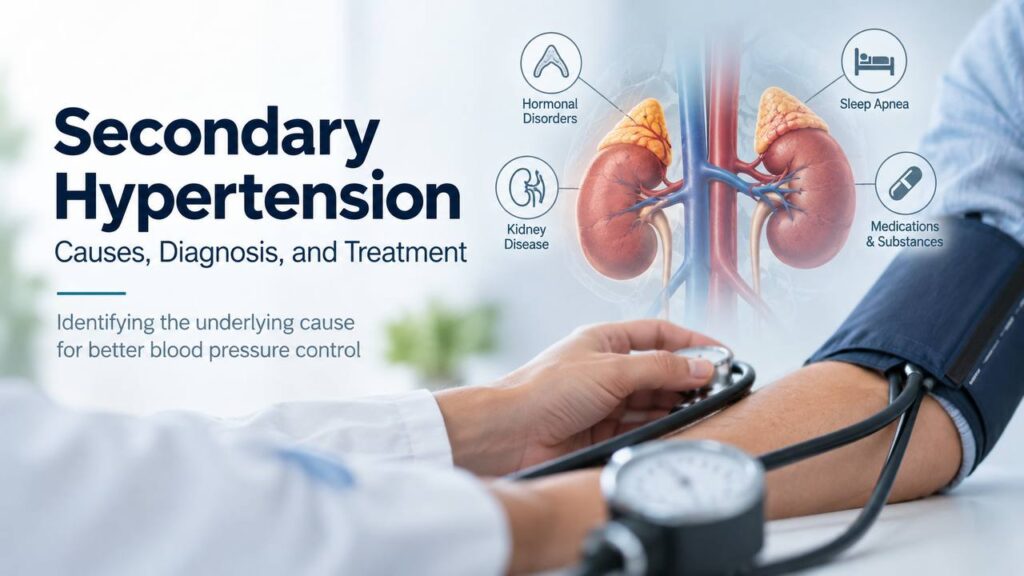
Secondary hypertension is high blood pressure caused by an identifiable underlying medical condition, medication, or substance. Unlike primary (essential) hypertension, which develops through a combination of genetic, lifestyle, and environmental factors, secondary hypertension results from a specific cause that may be treatable or reversible.
Early recognition is important because identifying and treating the underlying cause can improve blood pressure control, prevent complications, and, in selected patients, potentially resolve hypertension.
This article provides an overview of secondary hypertension, including its causes, warning signs, diagnostic evaluation, and treatment options.
1. What Is Secondary Hypertension?
Secondary hypertension occurs when elevated blood pressure develops as a consequence of another disease, condition, or exposure.
The underlying mechanism may involve:
-
Increased sodium and water retention.
-
Activation of the renin–angiotensin–aldosterone system (RAAS).
-
Excess production of hormones that increase blood pressure.
-
Increased sympathetic nervous system activity.
-
Medication- or substance-related effects.
Secondary hypertension is estimated to account for approximately 5%–25% of adult hypertension cases, depending on the population studied and diagnostic criteria. It is more frequently suspected in patients with resistant hypertension, sudden-onset hypertension, or early-onset hypertension.
2. Common Causes of Secondary Hypertension


A. Renal Parenchymal Disease
Kidney disease is an important cause of secondary hypertension. Reduced kidney function can lead to sodium and fluid retention, impaired blood pressure regulation, and increased activity of the RAAS.
Examples:
-
Chronic kidney disease (CKD).
-
Diabetic kidney disease.
-
Glomerulonephritis.
-
Polycystic kidney disease.
-
Chronic tubulointerstitial kidney disease.
Clinical clues:
-
Elevated serum creatinine or reduced eGFR.
-
Proteinuria or albuminuria.
-
Hematuria.
-
Abnormal renal ultrasound.
-
History of kidney disease or recurrent urinary infections.
Diagnostic evaluation:
-
Serum creatinine and eGFR.
-
Urinalysis.
-
Urine albumin-to-creatinine ratio.
-
Renal ultrasound.
-
Additional investigations according to suspected kidney disease.
Treatment focuses on the underlying renal disorder, blood pressure control, and prevention of progressive kidney damage.
B. Primary Aldosteronism
Primary aldosteronism occurs when the adrenal glands produce excessive aldosterone independently of the normal regulatory mechanisms.
Aldosterone promotes sodium retention and potassium excretion, contributing to hypertension and, in some patients, hypokalemia.
Possible causes:
-
Bilateral adrenal hyperplasia.
-
Aldosterone-producing adrenal adenoma.
-
Less common unilateral adrenal disorders.
Clinical clues:
-
Resistant hypertension.
-
Hypertension with hypokalemia.
-
Adrenal incidentaloma.
-
Early-onset hypertension.
-
Family history of early-onset hypertension or stroke.
Important clinical point: Normal serum potassium does not exclude primary aldosteronism. The 2025 AHA/ACC guideline recommends screening for primary aldosteronism in adults with resistant hypertension, regardless of whether hypokalemia is present.
Diagnostic evaluation:
-
Plasma aldosterone concentration.
-
Renin measurement.
-
Aldosterone-to-renin ratio (ARR).
-
Confirmatory testing when indicated.
-
Adrenal imaging and adrenal venous sampling in selected patients.
Treatment:
-
Mineralocorticoid receptor antagonists, such as spironolactone or eplerenone, particularly for bilateral disease or when surgery is not appropriate.
-
Adrenalectomy for selected patients with confirmed unilateral aldosterone excess.
Specialist assessment is recommended for diagnostic confirmation and treatment planning.
C. Renovascular Hypertension
Renovascular hypertension develops when narrowing of the renal arteries reduces renal perfusion and activates the RAAS.
Common causes:
-
Atherosclerotic renal artery stenosis.
-
Fibromuscular dysplasia.
Clinical clues:
-
Sudden onset or worsening hypertension.
-
Resistant hypertension.
-
Recurrent flash pulmonary edema.
-
Unexplained decline in renal function.
-
Possible renal function deterioration after initiation of RAAS-blocking therapy.
Diagnostic evaluation:
-
Renal artery Doppler ultrasound.
-
CT angiography (CTA).
-
Magnetic resonance angiography (MRA), when appropriate.
The choice of test depends on kidney function, the clinical context, and local expertise.
Treatment:
-
Medical management, including blood pressure and cardiovascular risk-factor control.
-
Revascularization in selected patients with clinically significant disease and appropriate indications.
Not every detected renal artery stenosis causes clinically significant renovascular hypertension.
D. Obstructive Sleep Apnea (OSA)
Obstructive sleep apnea is associated with intermittent upper-airway obstruction during sleep, intermittent hypoxemia, and sympathetic activation.
It is a common contributor to hypertension and may be particularly relevant in patients with resistant hypertension.
Clinical clues:
-
Loud snoring.
-
Witnessed apneas.
-
Gasping or choking during sleep.
-
Excessive daytime sleepiness.
-
Obesity or increased neck circumference.
-
Difficult-to-control blood pressure.
Diagnostic evaluation:
-
Sleep history and screening tools, such as STOP-Bang.
-
Home sleep apnea testing in suitable patients.
-
Polysomnography when indicated.
Treatment:
-
Weight management when appropriate.
-
Continuous positive airway pressure (CPAP) for eligible patients.
-
Management of contributing factors and sleep-related disorders.
OSA should be considered when the clinical history suggests sleep-disordered breathing.
E. Endocrine Causes
Several endocrine disorders can cause or contribute to hypertension.

1. Thyroid Disorders
Both hyperthyroidism and hypothyroidism may affect blood pressure.
Evaluation: TSH, with free T4 when indicated.

2. Pheochromocytoma and Paraganglioma
Catecholamine-producing tumors that may cause episodic or sustained hypertension.
Clinical clues: Episodic headache, palpitations, sweating, and sudden blood pressure elevation.
Evaluation: Plasma free metanephrines or urinary fractionated metanephrines, when clinically indicated.

3. Cushing Syndrome
Hypertension related to excessive cortisol exposure.
Clinical clues: Central weight gain, proximal muscle weakness, easy bruising, and characteristic skin changes.
Evaluation: Appropriate biochemical testing based on clinical suspicion.
Other endocrine causes include disorders of calcium regulation, particularly primary hyperparathyroidism, which may be associated with hypertension.
Endocrine testing should be guided by clinical findings rather than indiscriminate testing of every patient.
3. Medication- and Substance-Induced Hypertension
A detailed medication and substance history is essential when evaluating secondary hypertension.
Nonsteroidal anti-inflammatory drugs (NSAIDs)
Ibuprofen, diclofenac, naproxen, and other NSAIDs may increase blood pressure and reduce the effectiveness of certain antihypertensive medications.
Glucocorticoids
Prednisone and other corticosteroids may increase blood pressure through fluid retention and other metabolic effects.
Sympathomimetic medications
Some decongestants, including pseudoephedrine, can raise blood pressure.
Hormonal and other medications
Certain oral contraceptives, immunosuppressive medications, and other agents may contribute to elevated blood pressure.
Other substances
Excessive alcohol intake, stimulants, illicit drugs, and some herbal products may affect blood pressure.
Clinical practice: Review prescribed medications, over-the-counter products, supplements, herbal preparations, and recreational substances. Where feasible and clinically appropriate, consider alternatives or discontinuation of causative agents.
4. When Should You Suspect Secondary Hypertension?
Not every patient with hypertension requires extensive testing for every possible secondary cause. However, certain findings should increase clinical suspicion.
1. Early-onset hypertension
Hypertension diagnosed at a young age, particularly before 30 years, warrants consideration of secondary causes.
2. Resistant hypertension
Blood pressure remains above goal despite appropriate use of three antihypertensive medications, typically including a diuretic, or requires four or more medications for control.
3. Sudden onset or worsening
A previously controlled patient develops new or substantially worsening hypertension without an obvious explanation.
4. Severe blood pressure elevation
Markedly elevated blood pressure, especially when accompanied by clinical features suggesting an underlying cause.
5. Unexplained electrolyte abnormalities
Hypokalemia, particularly when not explained by diuretic therapy, may suggest primary aldosteronism.
6. Target-organ damage disproportionate to hypertension duration
Significant kidney, cardiovascular, or cerebrovascular involvement may warrant further evaluation.
These clinical features are consistent with guideline recommendations for investigating secondary hypertension when there is clinical suspicion.
5. Diagnostic Approach to Secondary Hypertension
A systematic evaluation helps identify the underlying cause while avoiding unnecessary testing.


Step 1: Confirm the Diagnosis of Hypertension
-
Use proper blood pressure measurement technique.
-
Repeat measurements when appropriate.
-
Consider home blood pressure monitoring or ambulatory blood pressure monitoring.
-
Assess for white-coat hypertension or masked hypertension when relevant.
Step 2: Detailed History and Physical Examination
Key areas include:
-
Age at hypertension onset.
-
Family history of hypertension, kidney disease, and endocrine disorders.
-
Medication and substance use.
-
Symptoms of sleep apnea.
-
Episodes of headache, sweating, and palpitations.
-
Symptoms suggesting kidney or endocrine disease.
-
Evidence of cardiovascular or renal target-organ damage.
Step 3: Initial Laboratory Evaluation
Common investigations may include:
|
Investigation |
Purpose |
|---|---|
|
Serum electrolytes |
Assess potassium and sodium abnormalities |
|
Creatinine and eGFR |
Evaluate kidney function |
|
Urinalysis |
Identify hematuria and other abnormalities |
|
Urine ACR |
Assess albuminuria |
|
Glucose or HbA1c |
Evaluate metabolic risk |
|
TSH |
Assess thyroid dysfunction when indicated |
The selection of additional tests depends on the suspected cause and clinical presentation.
Step 4: Targeted Testing
|
Suspected cause |
Potential screening or diagnostic test |
|---|---|
|
Primary aldosteronism |
Aldosterone-to-renin ratio |
|
Renovascular disease |
Renal artery Doppler, CTA, or MRA |
|
Obstructive sleep apnea |
Sleep study |
|
Pheochromocytoma |
Plasma or urinary metanephrines |
|
Cushing syndrome |
Appropriate cortisol-based testing |
|
Thyroid disease |
TSH ± free T4 |
|
Renal parenchymal disease |
Urinalysis, ACR, renal imaging, and cause-specific testing |
Clinical note: Positive screening results often require confirmatory testing, consideration of medication effects, and specialist interpretation.
6. Treatment of Secondary Hypertension
The primary goal is to control blood pressure and address the underlying cause.
1. Treat the Underlying Cause
Targeted treatment may substantially improve blood pressure control and reduce cardiovascular and kidney-related risks.
2. Antihypertensive Medications
Select therapy according to the cause, kidney function, electrolytes, comorbidities, and blood pressure severity.
3. Lifestyle and Risk-Factor Management
Appropriate dietary sodium reduction, physical activity, weight management, and other cardiovascular risk-factor interventions support overall blood pressure control.
4. Specialist Referral
Consider referral to a hypertension specialist, nephrologist, endocrinologist, or other appropriate specialist when diagnostic confirmation or complex treatment is needed.
Examples of Cause-Specific Treatment
|
Cause |
Treatment approach |
|---|---|
|
Primary aldosteronism |
Mineralocorticoid receptor antagonist or surgery in selected cases |
|
Renal parenchymal disease |
Kidney disease management and blood pressure control |
|
Renovascular hypertension |
Medical therapy; revascularization for selected indications |
|
Obstructive sleep apnea |
CPAP when indicated and management of contributing factors |
|
Medication-induced |
Review and adjust causative medication when clinically feasible |
|
Pheochromocytoma |
Specialist-directed biochemical evaluation and tumor management |
The appropriate treatment plan must be individualized to the patient’s diagnosis and clinical status.
7. Complications of Untreated Secondary Hypertension
Poorly controlled hypertension, whether primary or secondary, can cause progressive target-organ damage.
Potential complications include:
Cardiovascular disease
Heart failure, coronary artery disease, and left ventricular hypertrophy.
Stroke
Ischemic stroke and intracerebral hemorrhage.
Kidney damage
Progressive CKD and albuminuria.
Eye complications
Hypertensive retinopathy and vision-threatening damage.
Early diagnosis and effective blood pressure control are important components of reducing long-term cardiovascular and renal risk.
8. Secondary Hypertension: Clinical Case Example
Case presentation
A 35-year-old patient presents with persistent hypertension despite treatment with three antihypertensive medications, including a diuretic. Blood pressure remains elevated, and laboratory testing reveals unexplained hypokalemia.
Clinical considerations:
-
Confirm adherence and accurate blood pressure measurements.
-
Review medications and contributing substances.
-
Assess renal function and urinary findings.
-
Screen for primary aldosteronism using the aldosterone-to-renin ratio.
-
Arrange confirmatory testing and specialist assessment when appropriate.
Learning point: Resistant hypertension with hypokalemia should raise suspicion for primary aldosteronism. However, primary aldosteronism can occur without hypokalemia, so normal potassium levels do not exclude the diagnosis.
9. When to Seek Urgent Medical Attention
Patients with significantly elevated blood pressure and symptoms of possible acute target-organ damage require urgent assessment.
Seek emergency medical care for symptoms such as:
-
Chest pain or severe shortness of breath.
-
New neurological deficits, facial drooping, or difficulty speaking.
-
Severe headache accompanied by neurological symptoms or altered consciousness.
-
Acute visual loss.
-
Seizures or confusion.
The urgency of management depends on the blood pressure level, symptoms, examination findings, and evidence of acute organ injury. A severely elevated blood pressure reading alone does not establish a hypertensive emergency.
10. Key Takeaways
Secondary hypertension has an identifiable underlying cause.
Consider secondary causes in resistant, early-onset, sudden-onset, or otherwise suspicious hypertension.
Common causes include kidney disease, primary aldosteronism, obstructive sleep apnea, and renovascular disease.
Normal potassium does not exclude primary aldosteronism.
Medication and substance review is an essential part of the evaluation.
Identifying and treating the underlying cause may improve blood pressure control and reduce complications.
Conclusion
Secondary hypertension is an important and potentially treatable cause of elevated blood pressure. Clinicians should maintain a high index of suspicion when patients present with resistant hypertension, early-onset disease, sudden worsening of blood pressure, or clinical features suggesting a specific underlying condition.
A structured diagnostic approach, targeted investigations, and individualized treatment can improve patient outcomes. Primary aldosteronism, kidney disease, obstructive sleep apnea, and medication-related hypertension deserve particular attention in clinical practice.
Early recognition, accurate diagnosis, and appropriate treatment are essential for effective hypertension management.
References and Clinical Guidelines
-
2025 AHA/ACC Guideline for the Prevention, Detection, Evaluation and Management of High Blood Pressure in Adults. American Heart Association / American College of Cardiology.
-
2024 ESC Guidelines for the Management of Elevated Blood Pressure and Hypertension. European Society of Cardiology.
-
2025 AHA/ACC Guideline — Secondary Forms of Hypertension. Journal of the American College of Cardiology.